
The Trust Triad: How Agentic AI, Pindrop, and Anonybit Redefine Enterprise Security 2026

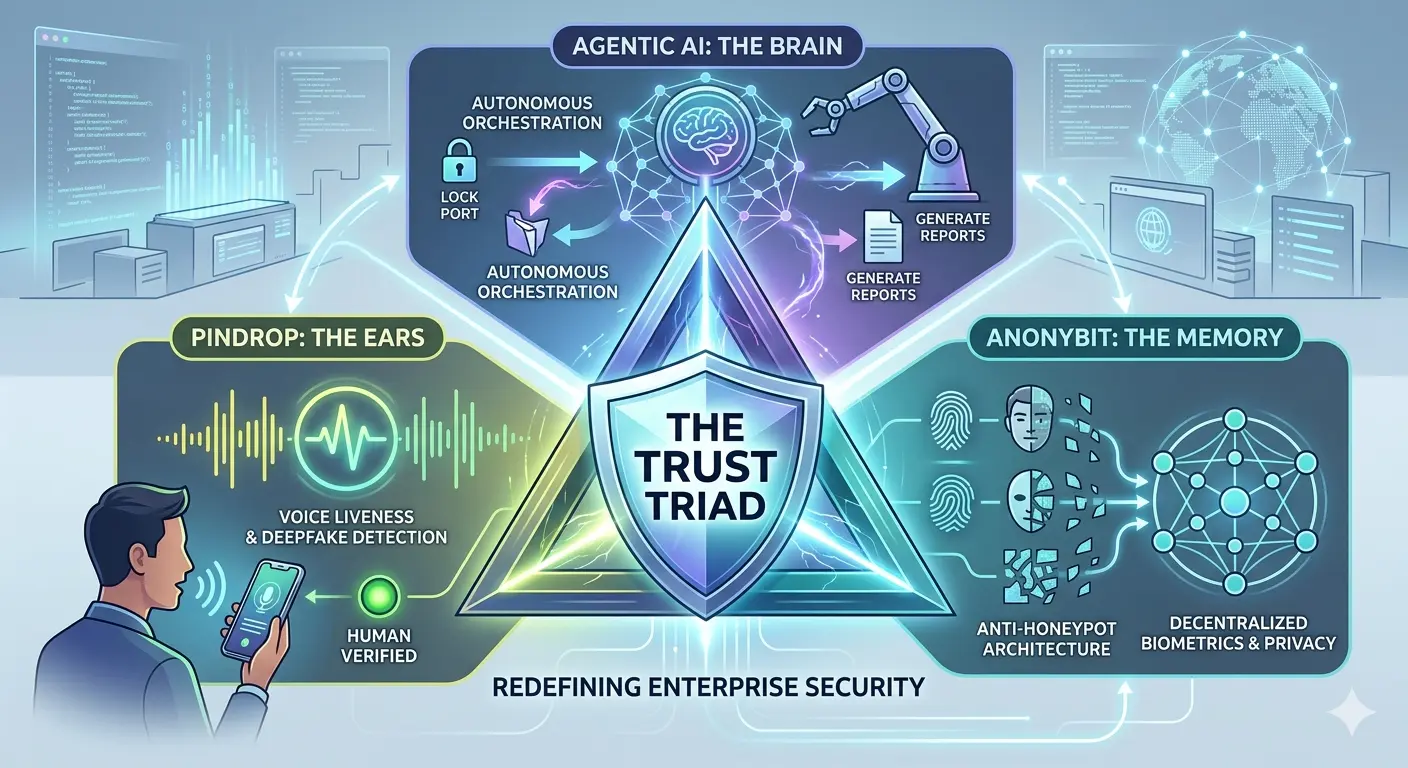
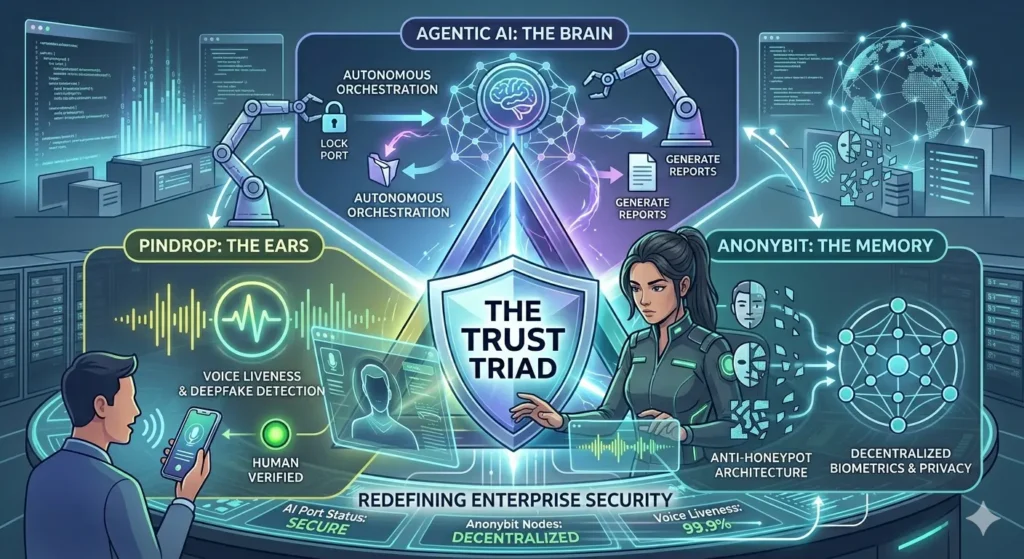
An enterprise security infographic titled "THE TRUST TRIAD" at its center within a glowing shield. The graphic is set in a modern digital operations center with server racks and screens displaying data. Arrows connect three main components to the central triad. At the top is "AGENTIC AI: THE BRAIN" for "AUTONOMOUS ORCHESTRATION," showing icons like locking ports and generating reports. On the left is "PINDROP: THE EARS" for "VOICE LIVENESS & DEEPFAKE DETECTION," with a man speaking into a phone showing a waveform and "HUMAN VERIFIED." On the right is "ANONYBIT: THE MEMORY" for "ANTI-HONEYPOT ARCHITECTURE" and "DECENTRALIZED BIOMETRICS & PRIVACY," displaying stylized faces, fingerprints, and a complex network. Text at the bottom states "REDEFINING ENTERPRISE SECURITY."

Imagine it is 3:00 AM. Your phone vibrates on the nightstand—not with a standard notification, but with a high-priority alert from your Security Operations Center (SOC). A high-value wire transfer was just initiated by your CFO. The voice on the recorded line was perfect. The credentials used were valid. Every traditional check-box was ticked.

Yet, your system flagged it as a fraud.

Why? Because your enterprise has moved beyond the “castle and moat” era of security. You are no longer just reacting to threats; you are anticipating them through a sophisticated, autonomous ecosystem. This is the reality of the Trust Triad. By weaving together Agentic AI, Pindrop, and Anonybit, you aren’t just building a bigger wall; you are creating a digital immune system that understands liveness, decentralizes identity, and acts with the speed of thought.

In this deep dive, we will explore how these three revolutionary technologies converge to solve the most pressing crisis in modern business: the total collapse of traditional trust.


Defining the Players: Who is the Trust Triad?

To understand how you can protect your organization in a world dominated by generative AI threats, you first need to understand the three pillars of modern defense. Each addresses a specific failure point in the legacy security stack.

Agentic AI: The “Brain” of the Operation

You’ve likely interacted with LLMs (Large Language Models) that answer questions. Agentic AI is different. It doesn’t just “know” things; it “does” things. It has agency. In your security architecture, Agentic AI acts as the connective tissue. It perceives an environment, reasons through a problem, and executes a multi-step plan to resolve it. Think of it as a senior security engineer that lives inside your network, capable of closing ports, revoking tokens, and investigating anomalies in milliseconds.

Pindrop: The “Ears” that Never Lie

As deepfake audio becomes indistinguishable from human speech to the naked ear, your call centers and remote authentication protocols are under siege. Pindrop provides the solution through voice liveness detection. It doesn’t listen to the words spoken; it analyzes the physics of the sound. By identifying the tell-tale signs of synthetic audio or digital playback, Pindrop ensures that when you hear a “person” on the other end, they are actually made of flesh and blood.

Anonybit: The “Memory” without a Target

The biggest vulnerability in your company is likely your biometric database. If you store thousands of faces or fingerprints in one central server, you’ve created a “honeypot” for hackers. Anonybit changes this by decentralizing identity. It takes a biometric template, breaks it into encrypted fragments, and scatters them across a decentralized cloud. There is no central record to steal, making your users’ identities virtually unhackable.

How Agentic AI, Pindrop, and Anonybit Work Together

When you integrate these three, you transition from a reactive posture to a proactive orchestration. Let’s look at how this triad manages a high-stakes authentication event in real-time.

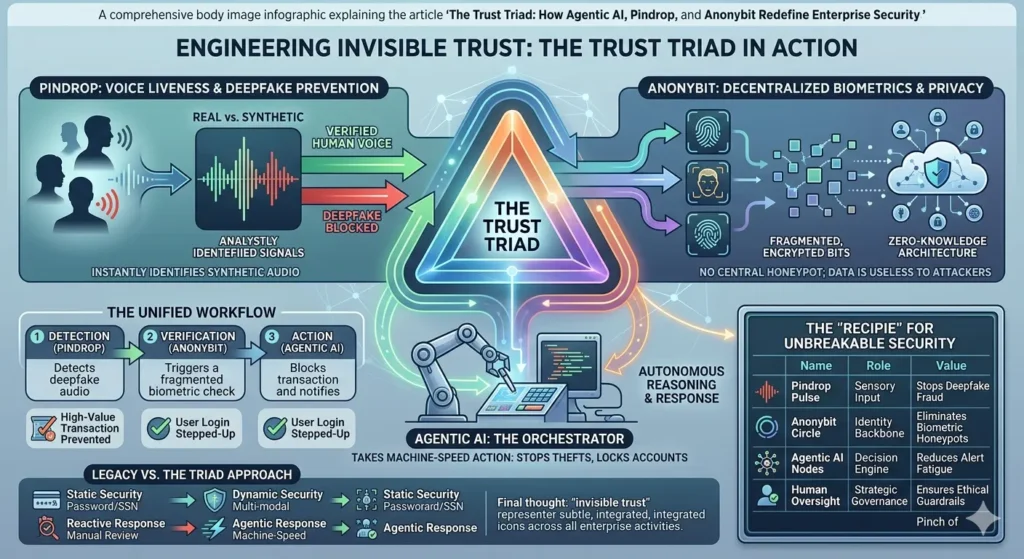
The Unified Workflow

  1. Detection: A user attempts to access a restricted terminal via voice command. Pindrop immediately analyzes the audio stream for “liveness.”
  2. Verification: Simultaneously, the system requests a biometric “proof.” Anonybit retrieves encrypted fragments from across the network to verify the user without ever reconstructing the full biometric image in a single location.
  3. Action: The Agentic AI monitors this interaction. If Pindrop flags a 10% chance of synthetic audio, the AI doesn’t wait for a human. It autonomously decides to “step up” the authentication, perhaps requiring a hardware-based security key or a secondary biometric check, and alerts the SOC.

Comparative Analysis of Security Layers

To see why you need this triad, look at how it compares to the legacy systems you might still be running.

Security ComponentTraditional ApproachThe Trust Triad (Agentic AI, Pindrop, Anonybit)
Authentication SourceStatic Passwords/SSNDynamic Voice Liveness & Decentralized Biometrics
Threat ResponseManual/Rule-basedAutonomous/Agentic Reasoning
Storage RiskCentralized HoneypotsFragmented & Anonymous
Deepfake DefenseNone (Human judgment)Algorithmic Liveness Detection
ScalabilityHigh overhead for SOCMachine-speed automation

Solving the “Honeypot” Problem with Anonybit

You have probably spent millions of dollars securing your data, but have you considered the liability of your biometric storage? Under regulations like GDPR and CCPA, a breach of biometric data isn’t just a technical failure; it’s a legal catastrophe.

Anonybit allows you to adopt a “Zero-Knowledge” architecture. When you use Anonybit, you aren’t actually “storing” biometrics. You are storing mathematical representations that are useless on their own. This removes the incentive for attackers. If there is no central vault to crack, the “Return on Investment” for a hacker drops to zero. You are effectively making your enterprise an “identity-empty” target while maintaining the highest levels of user verification.


Countering Deepfakes with Pindrop Pulse

If you think your team can spot a deepfake, you are already behind. Modern “speech-to-speech” models can mimic tone, breathing patterns, and emotional inflection with 99% accuracy. Your contact centers are the front line of this war.

By implementing Pindrop, you provide your frontline staff with a “trust score” for every call. Pindrop Pulse detects:

  • Synthetic Speech: Audio generated by AI models.
  • Replay Attacks: Recorded voices played back through a device.
  • Voice Clones: AI-generated replicas of specific individuals.

This isn’t just about security; it’s about customer experience. When you trust the voice, you can reduce those annoying “security questions” that frustrate your genuine clients, streamlining your operations while tightening the net for fraudsters.


The Rise of Agentic AI as the Enterprise Orchestrator

The “secret sauce” that makes this triad work is the Agentic AI. For years, we’ve had AI that flags alerts—and then sits there waiting for a human to click “Approve” or “Deny.” That delay is where the damage happens.

Agentic AI acts as the “General” on the digital battlefield. It uses the data from Pindrop and Anonybit to make contextual decisions. For instance, if a user is verified via Anonybit but Pindrop detects high background noise consistent with a “fraud farm” environment, the Agentic AI can choose to limit the user’s transaction limit to $500 until a human can review the case. You are moving from a binary “Yes/No” security model to a nuanced, risk-weighted model that operates at the speed of the internet.

H3: The Recipe for an Unbreakable Security Stack

To implement this in your organization, think of it as a recipe where the quality of the ingredients determines the safety of the outcome.

IngredientRole in the TriadValue to the Enterprise
Pindrop PulseSensory InputEliminates “Identity Theft by Voice” and deepfake fraud.
Anonybit CircleIdentity BackboneRemoves the liability of biometric data storage.
Agentic AI NodesDecision EngineAutomates response, reducing “Alert Fatigue” for your team.
Zero Trust PolicyGovernanceEnsures no user is trusted by default, regardless of rank.

Frequently Asked Questions (FAQ)

How do Agentic AI, Pindrop, and Anonybit protect against insider threats?

While Pindrop and Anonybit verify the “who,” Agentic AI monitors the “what.” Even if an insider is authenticated, the Agentic AI tracks their behavior. If a trusted employee suddenly starts downloading the entire client database at 2:00 AM, the AI recognizes the anomaly and revokes access instantly.

Is this Triad difficult to integrate with legacy IAM systems?

No. Most modern enterprises use this triad as an “augmentation layer.” You don’t have to rip and replace your existing Identity and Access Management (IAM) stack. Anonybit and Pindrop plug into your existing flows via APIs, while Agentic AI sits on top as the orchestrator.

Does decentralized biometric storage affect the speed of login?

Surprisingly, it can be faster. Because Anonybit uses fragmented parallel processing, the verification often happens in under a second—comparable to or faster than traditional centralized database lookups, all while being significantly more secure.

What is the ROI of implementing the Trust Triad?

The ROI is measured in three ways:

  1. Fraud Prevention: Directly stopping million-dollar deepfake transfers.
  2. Efficiency: Reducing the time your SOC team spends on “false positives.”
  3. Compliance: Lowering insurance premiums and legal risks by eliminating biometric “honeypots.”

Conclusion: Engineering a Future of Invisible Trust

The “Trust Triad” represents a fundamental pivot in how you must think about security. We are leaving the era where you can trust what you see or hear. In its place, you must build a system where trust is earned through liveness, protected through decentralization, and enforced through autonomous agency.

By leveraging Agentic AI, Pindrop, and Anonybit, you are doing more than just stopping hackers; you are building a foundation of “Invisible Trust” that allows your business to move faster, innovate harder, and lead with confidence in the age of AI.

Don’t wait for the 3:00 AM alert that you can’t stop.

Call to Action

The window for “wait and see” has closed. If your enterprise is still relying on centralized biometrics and human-ear verification, you are one deepfake away from a crisis. Contact our security consultants today for a comprehensive audit of your identity stack and learn how the Trust Triad can be customized for your specific workflow. Let’s make your enterprise unhackable, together.


Claude AI Price Guide 2026: Is the New Max Plan Worth $100?

A sleek, high-tech hero image featuring a futuristic, translucent "nano banana" with glowing internal circuitry and fiber-optic lights resting on a modern mechanical keyboard. In the background, a computer monitor clearly displays the article headline: "Claude AI Price Guide 2026: Is the New Max Plan Worth $100?" The scene is set in a professional, dimly lit workspace with cool blue and purple ambient lighting, emphasizing a high-end AI technology theme.

We’ve all been there: staring at a “message limit reached” notification right in the middle of a breakthrough. Whether you’re a developer racing against a deadline or a creator in the flow of a new project, that sudden halt feels like a door slamming in your face. It’s frustrating because your tools should keep up with your ambition, not throttle it.

With the release of the Claude AI Max Plan, Anthropic is promising to throw those doors wide open—but at a triple-digit price point. It feels like a massive leap from the standard $20 we’ve grown used to. You might be wondering if this is finally the solution for your high-intensity workflows or just another monthly bill that drains your budget. Let’s break down the value and see if it’s truly time for you to upgrade.


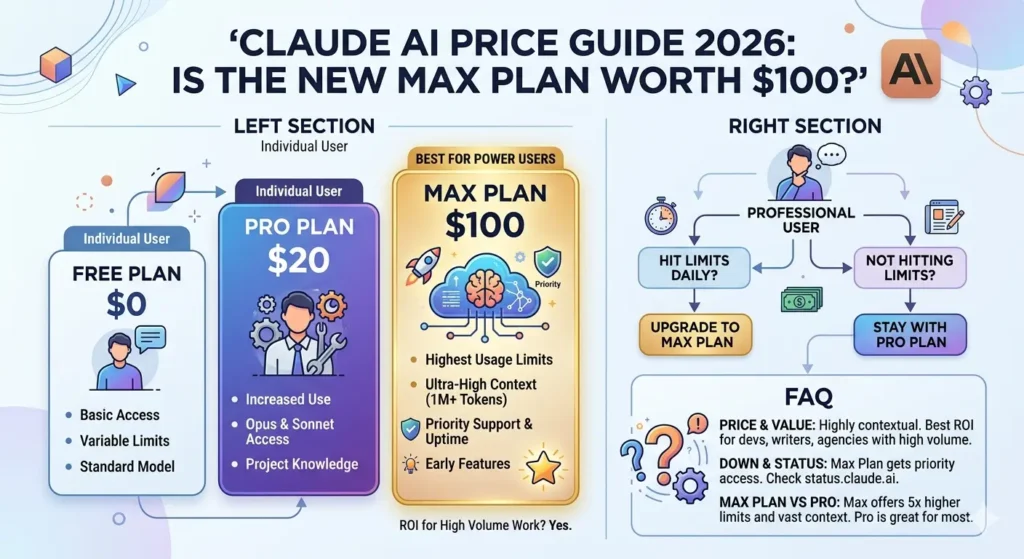
1. Understanding the 2026 Claude AI Price Tiers

The landscape of generative AI has shifted toward high-capacity usage in 2026. Gone are the days when AI was just a chatbot; it’s now an infrastructure. Anthropic has restructured its offering to cater to everyone from the casual prompt-engineer to the professional architect.

The Evolution of Anthropic’s Pricing

Anthropic has moved away from a “one-size-fits-all” paid model. As of early 2026, the Claude AI price reflects a tiered ecosystem designed to prevent heavy users from being throttled. While the Free tier remains a great entry point, the gap between “Pro” and “Max” has become the primary talking point in the tech community.

Current Tiers Overview

If you’re trying to figure out where you fit, here is how the landscape looks today:

  • The Free Tier: Best for light research and casual writing. It uses a variable limit that resets every five hours.
  • The Pro Tier ($20/mo): The gold standard for most. It grants access to Claude Code and higher usage than the free version.
  • The Max Tier ($100/mo): The new “powerhouse” plan. It offers 5x the usage of Pro, higher output limits, and priority during server spikes.

Comparison of Subscription Tiers

FeatureFree PlanPro PlanMax Plan
Monthly Price$0$20$100
Model AccessSonnet 4.6 (Limited)Opus 4.6 & Sonnet 4.6Priority Opus 4.6 & “Ultra”
Message Limits~15-40 per 5h~45 per 5h~225 per 5h
Context WindowStandard200k Tokens1M+ Tokens
Project KnowledgeLimitedStandardEnhanced Sync

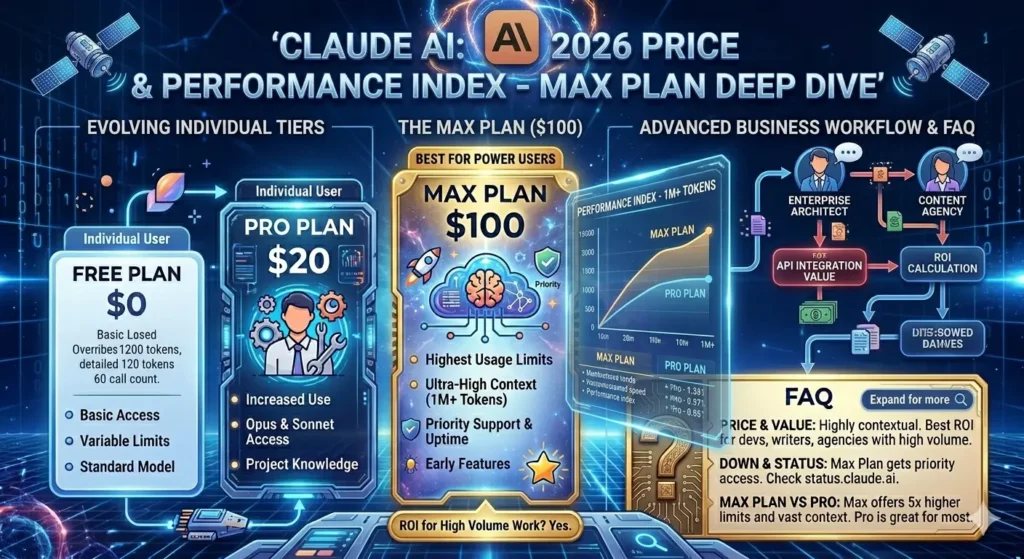
2. Deep Dive: What Do You Get for a $100 Claude AI Price?

A hundred dollars a month is a significant investment for a single software tool. To justify this, you need to look beyond the chat box.

The “Unlimited” Myth vs. Reality

In 2026, “unlimited” is rarely absolute. On the Max plan, you effectively get 500% more headroom than a Pro user. For a developer using Claude Code in the terminal, this means you can keep your agent running through complex refactoring tasks without seeing a “Usage Limited” warning before lunch. It’s about maintaining a state of flow.

The 1-Million Token Advantage

The massive context window is where the Claude AI price starts to make sense for specific professionals.

  • For Coders: You can feed an entire codebase into a single session.
  • For Researchers: You can upload multiple 500-page PDF documents and ask Claude to find contradictions between them.
  • For Writers: You can maintain the entire history of a 100,000-word novel in active memory, ensuring Claude never forgets a character’s eye color from Chapter 1.

Early Access to “Claude Code” and “Cowork”

Max users are the first to receive “Research Preview” features. Whether it’s the latest iteration of autonomous agentic workflows or new multi-modal tools that allow Claude to “see” and interact with your desktop, the Max plan ensures you’re at the front of the line.


3. Performance During Downtime: Does the Max Plan Keep You Online?

Reliability is a silent feature. When the rest of the world is seeing a Claude AI down message, Max users are often still operating on priority lanes.

Priority Server Access

During peak hours—usually Tuesday mornings when the corporate world is in full swing—compute resources get stretched. Anthropic uses “Priority Routing” for Max subscribers. While a Free or Pro user might experience “Thinking…” delays of 30 seconds, a Max user typically sees near-instant responses.

Handling a “Claude AI Status” Emergency

Even a $100 subscription can’t prevent a major AWS outage, but the way you’re treated during a recovery matters.

  • Dedicated Support: Max users have access to an expedited support channel.
  • Status Transparency: You get more granular updates on the Claude AI status via the subscriber dashboard, helping you decide whether to wait out a glitch or switch to a backup tool.

4. ROI Analysis: Who is the Max Plan For?

You need to treat this plan as a business expense. If it doesn’t save you time or generate more than $100 in value, it’s not for you.

The Developer’s Perspective

If you are a software engineer, your time is likely worth more than $50/hour. If hitting a message limit on the Pro plan costs you just two hours of productivity per month, the Max plan has already paid for itself. The ability to use Claude as a persistent pair-programmer in the terminal is a force multiplier.

The Content Agency & Marketing Expert

For those running high-volume workflows—like managing a subreddit or a WordPress blog with AI-assisted drafting—the higher output limits are essential. You can generate longer, more detailed articles (up to 5,000 words in one go) without the model getting “tired” or losing the thread.

The Student/Hobbyist “Sweet Spot”

Honestly? If you’re just using AI to summarize your homework or write emails, stay on the Pro plan. The Claude AI price for the Max tier is a “Pro-sumer” and “Professional” bracket. Don’t pay for 1 million tokens of context if you’re only ever sending 500-word prompts.


5. Maximizing Your Subscription: Tips for Claude AI Power Users

If you decide to take the plunge, don’t just use it like a better version of the Free tier. You need to leverage the architecture.

  • Utilize “Projects” for Every Client: Don’t mix your workflows. Create a Project for each major task to keep the “System Prompt” and “Knowledge Base” clean.
  • Use the /compact Command in Claude Code: Even with high limits, keeping your terminal sessions lean saves you from “context bloat” and keeps responses snappy.
  • Leverage Artifacts for UI Prototyping: Use the Max plan’s high compute priority to render React or Tailwind code instantly in the side window. It’s like having a live front-end developer sitting next to you.

FAQ: Everything You Need to Know About Claude AI Price & Status

Is there a discount for the annual Claude AI price?

As of 2026, Anthropic has introduced an annual billing option for the Pro plan (roughly $17/mo), but the Max plan remains a monthly $100 commitment to allow users to scale up or down based on project needs.

Why is the Claude AI price higher than competitors?

Claude’s focus is on “Deep Reasoning” and “High Context.” While competitors might be cheaper for quick chat tasks, Claude’s ability to handle 1 million tokens with near-perfect recall is a high-cost infrastructure feat that justifies the premium.

What should I do if Claude AI is down?

Always check the official Claude AI status page at status.claude.ai. If you are on the Max plan and the site is functional but slow, try switching your model to “Haiku” for a faster, though less “intelligent,” response to get through the crunch.

Can I share my Max Plan account with my team?

The Max plan is an individual license. For multi-user environments, the “Claude for Teams” or “Enterprise” tiers are more cost-effective and offer centralized billing and admin controls.


Conclusion

Deciding if the Claude AI price for the Max Plan is worth it comes down to one question: How much is your “flow state” worth? If you are a professional whose day involves deep-diving into massive datasets, managing complex code repositories, or producing high-volume content, the Max plan isn’t a luxury—it’s a tool that removes the ceiling from your potential. The $100 price tag buys you the peace of mind that when you need the AI most, it will be there, it will remember everything you’ve said, and it won’t tell you to “come back in four hours.”

Ready to stop hitting limits? Evaluate your usage today. If you’ve seen that “limit reached” message more than twice this week, it might be time to invest in your productivity and make the switch to Max.

claude ai down, claude ai status, claude ai price

  • Is Claude AI better than ChatGPT?
  • Is Claude AI free?
  • What is the 30% rule for AI?
  • Is Claude made by Google?