How to Use AI to Narrate Your Audiobook: A Guide to ElevenLabs (2025)

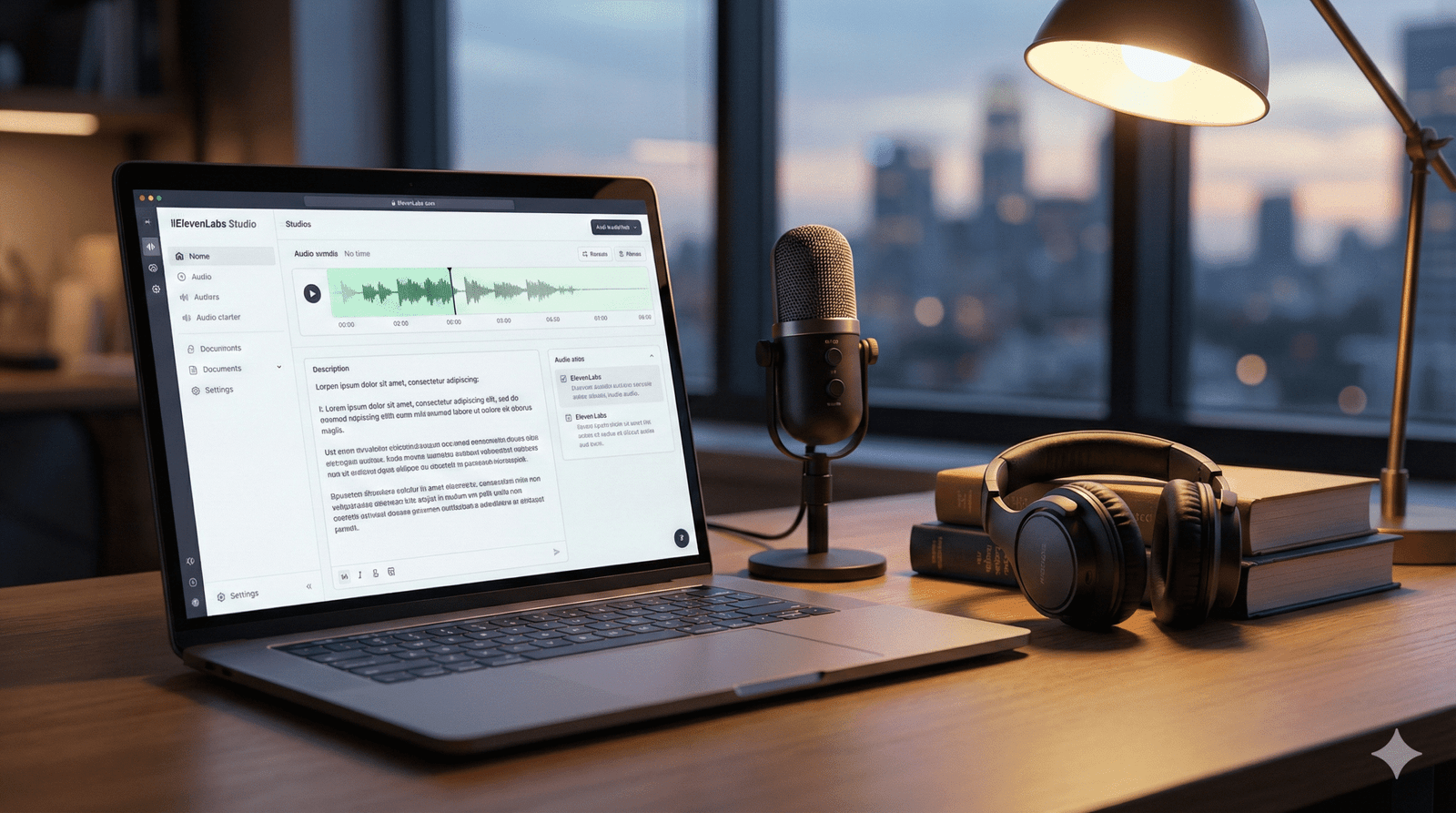
"A futuristic digital illustration of a sound wave transforming into an open book, symbolizing AI audiobook narration using ElevenLabs."

You have done a difficult job. You’ve spent months – maybe even years – struggling with plot holes, perfecting character arcs, and staring at a blinking cursor until your eyes water. Your manuscript is finished.

This has been edited. It has a killer cover. But there’s one nagging question your readers keep asking: “When is the audiobook coming out?” For most indie authors, this question is a sore one. You know the answer involves either spending $5,000 on a professional narrator or spending 60 hours in a closet trying to record it yourself without your dog barking in the background. So you keep quiet. You leave that revenue on the table.

But in 2025, silence is a choice, not a requirement. Enter ElevenLabs. We’re not talking about the robotic “GPS voices” of a few years ago. We’re talking about AI that breathes, pauses, whispers and acts. It may growl like a pirate or tremble like a broken lover. And the best? It costs less to produce a perfect novel than a fancy dinner. By the end of this guide, you’ll know exactly how to turn your manuscript into a broadcast-quality audiobook using ElevenLabs’ latest features.

Before you rush to generate your first chapter, we need to talk about the rules. The landscape of AI audio is a minefield of “Yes, but…” policies. Let’s clear them up so you don’t get your account banned.

The “Commercial Rights” Trap

This is the most common mistake authors make. You cannot use the “Free” plan on ElevenLabs to sell an audiobook.

  • Free Plan: Strictly for personal use or non-commercial demos.
  • Starter Plan ($5/mo) & Up: Includes a Commercial License. You own the rights to the audio files you generate, meaning you can sell them on your website, Google Play, or anywhere else that accepts AI audio.

The Golden Rule: If you plan to sell it, you must be on a paid tier while you are generating the audio. (You don’t need to stay subscribed forever, but you must be subscribed when you click “Generate.”)

Where Can You Actually Sell It?

Not every platform welcomes AI narrators with open arms.

  • The No-Go Zone: Amazon ACX / Audible. As of late 2025, they still strictly prohibit AI-narrated audiobooks (unless it is a clone of your own voice authorized through their specific beta program). Do not try to sneak it past them; they have detection tools.
  • The Green Light: Google Play Books, Kobo Writing Life, and direct sales platforms like Payhip or LemonSqueezy.
  • The “Yes, But” Zone: Voices by INaudio (formerly Findaway Voices) allows AI narration, but you must disclose it during the upload process. They distribute to dozens of retailers, including Spotify, that are AI-friendly.

Step 2: Choosing Your Narrator (Without Auditions)

You don’t need to listen to 50 audition tapes anymore. You just need to know what you are looking for. ElevenLabs gives you three powerful ways to find your voice.

Option A: The Voice Library (Fastest)

The library is massive. To avoid “analysis paralysis,” use the filters intelligently.

  • Filter by Use Case: Select “Narrative” or “Storytelling.” These voices are trained on long-form content, meaning they won’t sound bored after 5 minutes.
  • Check the Specs: Look for voices with a high “Stability” rating. You want a narrator who sounds consistent from Chapter 1 to Chapter 20.

Option B: Voice Design (Custom)

Can’t find the perfect gritty noir detective? Make him.

The Voice Design tool lets you prompt a new voice into existence.

  • The Prompt: “Middle-aged American male, deep gravelly voice, slow pacing, cynical but warm tone.”
  • The Result: ElevenLabs will generate a unique voice that nobody else has. This is perfect for giving your audiobook a signature sound that isn’t overused by other authors.

Option C: Voice Cloning (The Personal Touch)

  • Instant Cloning: You upload 1 minute of audio, and it mimics the voice. Great for quick character inserts.
  • Professional Voice Cloning (PVC): This is the “Gold Standard.” You upload 30+ minutes of clean audio (perhaps of you reading your book), and the AI creates a hyper-realistic replica. This allows you to narrate your book without spending 40 hours in a recording booth.

Step 3: Mastering the “Studio” (The Secret Weapon)

Do not—I repeat, do not—try to generate your audiobook in the standard “Speech Synthesis” box one paragraph at a time. You will lose your mind trying to stitch the files together.

Use the tool specifically designed for this: ElevenLabs Studio (formerly Projects).

Why Use Studio?

Studio acts like a Google Doc that speaks. It understands context. It knows that a sentence at the end of a paragraph should sound different than one in the middle.

The Workflow

  1. Import: You can upload your EPUB or PDF file directly. Studio will strip out the formatting and leave you with clean text.
  2. Assign Speakers: This is the killer feature. You can highlight a line of dialogue—say, “Get out of here!”—and assign it to a specific “Character Voice” (e.g., ‘Gruff Thug’). You can assign the rest of the text to your ‘Narrator’ voice. The AI handles the switching seamlessly.
  3. Pause Control: AI sometimes rushes. In Studio, you can manually insert pause blocks (0.5s, 1.0s) to create dramatic tension or signal a scene break.

Step 4: Breathing Life into AI (Advanced Emotions)

This is where you separate the amateurs from the pros. In 2025, the Eleven Multilingual V3 model introduced “Audio Tags.” These are like stage directions for your AI actor.

Instead of hoping the AI understands a scene is sad, you tell it.

How to Use Audio Tags

You type these commands directly into your text inside Studio. The AI reads the text but acts out the instruction.

Table 1: The “Audio Tag” Recipe Book

Emotion/ActionThe Tag PromptBest Used For
Secrets[whisper] "I found the key." [whisper]Thrillers, Mysteries, Intimate scenes
Relief[sigh] "Finally, it's over."Chapter endings, emotional climaxes
Joy[laugh] "You have to be kidding me!"Rom-Com banter, lighthearted moments
Anger[shout] "Get out!" [shout]Arguments, Action scenes
Hesitation[hesitates] "I... I don't know."Realistic dialogue, nervousness

Stability vs. Similarity Settings

If your narrator sounds too robotic, your settings are likely too high.

  • Stability: Turn this DOWN to 35-45%. Lower stability allows the AI to have more “inflection” and emotional range.
  • Similarity: Keep this HIGH (70-80%). This ensures the voice doesn’t accidentally morph into a different person halfway through a sentence.

Step 5: Post-Production & Exporting

You aren’t done when you click “Download.” To meet industry standards, you need to polish the files.

Export Settings

Always export your audio in MP3 192kbps (or higher). This is the standard quality requirement for almost every retail platform.

The “Human” Polish (Audacity Workflow)

Download the free software Audacity to do the final touches:

  1. Room Tone: Even though AI has no “background noise,” total digital silence feels unnatural to human ears. It can feel like your headphones died. Add a very faint “room tone” track underneath, or ensure you have 1-3 seconds of silence at the head and tail of every chapter.
  2. Speed Check: AI often reads about 10-15% faster than a professional human narrator. Select your entire track and use the “Change Tempo” effect to slow it down to 0.90x or 0.95x. This makes the listening experience more comfortable and “thoughtful.”

Frequently Asked Questions (FAQ)

Q: How much does it actually cost to narrate a full book?

A: Let’s do the math. An average novel is 60,000 words (~400,000 characters).

  • Creator Plan: You get ~100,000 characters per month for about $22.
  • The Strategy: You would need roughly 4 months of credits (or buy extra usage-based credits). Total cost is usually around $80 – $100. Compare that to the $3,000+ for a human narrator.

Q: Can I put my ElevenLabs audiobook on Spotify?

A: Yes! You can distribute to Spotify through Voices by INaudio (formerly Findaway). Just make sure you check the box that asks if the content is “AI Generated.” Honesty is the best policy here.

Q: Will listeners hate it?

A: Honest truth? Some will. There are purists who despise AI. However, for non-fiction, memoirs, and clean-cut genre fiction, the quality of the V3 model is now so high that casual listeners often cannot tell the difference. The key is in Step 4—using those emotional tags to stop it from sounding monotonous.

Conclusion

The gatekeeper left. You no longer need a studio, producers, or a four-figure budget to get your story across to your readers. ElevenLabs has democratized the audiobook industry, but the tool is only as good as the creator using it.

If you copy-paste your entire book and press “go”, you’ll get a mediocre product. But if you use a studio, direct the demo with audio tags, and improve the pace, you’ll create a comprehensive experience that rivals the big publishing houses. Your story is not only worth reading but also worth listening to.

Don’t let “perfect” be the enemy of “published.” Are you ready to hear your characters speak for the first time? Sign up for the ElevenLabs Starter Plan today and create your first chapter for less than the cost of a latte.

7 Best AI Book Cover Generators for Self-Publishers (Free & Paid)

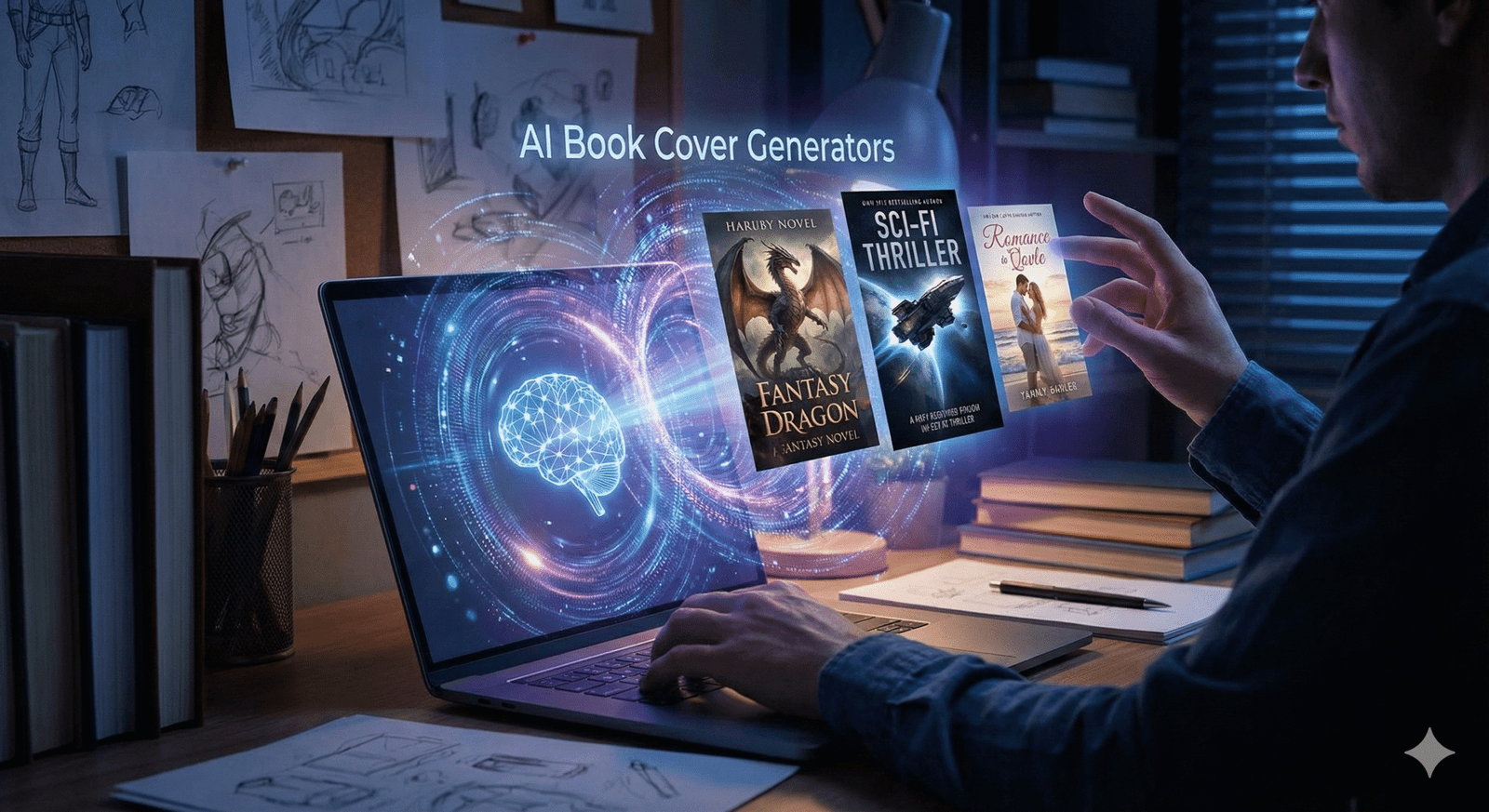
A person at a desk uses a laptop with a futuristic holographic interface displaying a glowing brain icon and three distinct book covers for fantasy, sci-fi, and romance genres, illustrating AI book cover generators in action.

AI book cover generator… You know the feeling. You’ve spent months—maybe even years—pouring your soul into a Google Doc. You’ve survived plot holes, wrestled with character arcs, and finally typed out “The End.” Your manuscript is ready to be presented to the world. But then, you hit the wall that stops most indie authors dead in their tracks: the cover. 

They say, “Don’t judge a book by its cover,” but believe the truth—on Amazon, the cover is the only thing people judge. It’s the difference between a reader clicking “Buy Now” or scrolling past your masterpiece without a second glance.

 In the past, you had two painful choices: spend over $500 for a professional designer, or struggle with a DIY cover that looks like a DIY cover. But 2025 has changed the game. With the best AI book cover generator tools available today, you can create industry-standard, stunning art for a fraction of the cost. Whether you’re writing a sweeping epic fantasy or a cozy mystery, AI is the equalizer that puts the power of a design studio in your pocket. Let’s take a look at the tools that will turn your manuscript into a bestseller.

Before we dive into the fun tools, we need to have a serious talk about the rules. If you are publishing on Amazon Kindle Direct Publishing (KDP), you cannot just upload and pray. The landscape has shifted, and ignorance of these rules can get your account flagged.

  • You Must Disclose: Amazon KDP now requires you to check a specific box during the upload process stating if you used AI to create your content or cover. Always check “Yes.” It won’t hurt your ranking—readers generally care about the aesthetic, not the origin—but lying about it violates the Terms of Service and puts your entire author career at risk.
  • Copyright is Tricky: Here is the legal nuance you need to know. generally, you cannot copyright the raw image generated by AI because it lacks “human authorship.” However, you can claim copyright on the final composition. This means the specific arrangement of that image combined with your unique typography, title placement, and author name is protectable.
  • The “Uncanny Valley” Risk: Amazon is cracking down on low-effort content. If your cover has a character with seven fingers or text that looks like alien hieroglyphics, it signals “low quality” to Amazon’s algorithms. Quality control is your safety net.

Now that we are legal, let’s get creative.

The “Big Guns”: Top Paid AI Generators

If you want your book to look like it was published by a major house like Penguin Random House or Tor, you need the heavy hitters. These tools require a subscription, but they often pay for themselves from a single book sale.

1. MidJourney v6 (The Gold Standard) If you ask any professional AI artist what they use, the answer is almost always MidJourney. Currently in version 6 (v6), this tool understands textures, lighting and style better than anything else on the market. Vibe: It excels in high-concept genres like fantasy, science-fiction, and horror. It can create oil paintings that look as if they belong in a museum, watercolors that flow realistically, or hyper-realistic cinematic shots. The catch: It runs entirely inside Discord. Typing commands in a chat room full of other people feels clunky at first, but the results are unmatched in terms of artistic coherence. Why use it? If you need a specific aesthetic – like “cyberpunk noir” or “Victorian Gothic” – Midjourney nails the atmosphere every time.

2. DALL-E 3 (via ChatGPT Plus) If the Midjourney is the singular performer, the DALL-E 3 is the supporting assistant. Available directly inside ChatGPT Plus, you can talk to it in plain English, making it the most user-friendly option for beginners. Superpower: It listens. If you tell DALL-E, “Make the dragon red, not blue,” or “Put a lighthouse in the background,” it does exactly that. Midjourney often struggles with such specific spatial instructions. The downside: It has a distinct “shiny” look. You often need to be told “avoid shiny AI 3D rendered look” to get something that looks organic and gritty enough for a thriller or mystery.

Best Free (and Freemium) Alternatives

Best Free (and Freemium) Alternatives Budget tight? I understood. From editing to marketing, self-publishing is expensive. Here are the best AI book cover generator options that won’t break the bank.

3. Leonardo.AI (Best Free Alternative) This is arguably the best free alternative to MidJourney. Leonardo offers a generous amount of free credits daily, meaning you can generate dozens of ideas every day without spending a dime. Why authors like it: It has “sophisticated models.” You can select models specifically trained on “RPG Characters” or “ Vintage Photography ” to get the exact look without being an instant engineer. Feature: It creates incredible character portraits. If your romance novel hinges on the hero’s smoldering gaze, start here. This allows you to generate a consistent character format, which is extremely difficult with other tools.

4. Microsoft Designer (Bing Image Creator) Believe it or not, Microsoft offers one of the most powerful tools for free. It uses the DALL-E 3 engine under the hood. Although it has fewer controls than ChatGPT, it is completely free to use with a Microsoft account. It’s perfect for quick brainstorming or testing concepts before committing to a paid tool.

The “All-in-One” Design Suite

Here is a secret: AI is terrible at text.

If you ask an image generator to write your title, it will likely spit out garbled, alien-looking letters. That is why you need a hybrid approach.

5. Canva (Magic Media)

You probably know Canva, but have you used their “Magic Media” tool? This is where your cover actually comes together.

  • The Workflow: You use Canva’s AI (or upload an image from Midjourney) to serve as the background. Then, you use Canva’s human tools to overlay your title and author name.
  • Why it ranks: It solves the typography problem. A great image with a bad font choice looks amateur. Canva creates the bridge between the two, offering templates that ensure your text is centered, legible, and genre-appropriate.

The Secret Sauce: Prompt Recipes for Authors

Using an AI generator is like cooking. If you just throw random ingredients in a pot, you get a mess. You need a recipe.

When crafting your prompt, don’t just say “a scary house.” Be specific. Use this “Prompt Recipe” table to build your perfect description.

Table 1: The Book Cover “Prompt Recipe”

Ingredient (Variable)Fantasy ExampleRomance ExampleThriller Example
SubjectA hooded assassin standing on a cliff edgeA couple laughing in a rainy cafe, forehead to foreheadA lone silhouette at the end of a dark hallway
Art StyleOil painting, Frank Frazetta styleSoft watercolor, dreamy, pastel tonesHigh contrast photography, cinematic, 35mm lens
LightingGolden hour, magical glow, bioluminescentSoft diffused light, warm candle lightHarsh shadows, noir lighting, blue moonlight
MoodEpic, dangerous, mysteriousWhimsical, cozy, intimateTense, suspenseful, gritty
Aspect Ratio--ar 2:3 (Standard eBook size)--ar 2:3--ar 2:3

Pro Tip: Always add “negative space at the top” or “minimalist sky” to your prompt. This tells the AI to leave an empty area in the composition where you can easily place your book title later without covering up the main character’s face.


Step-by-Step Guide: From Prompt to Published Cover

Having a cool image isn’t enough. If you upload a raw AI image to Amazon, it might look blurry or “off.” Here is the professional workflow to take that raw generation and turn it into a file ready for Amazon KDP.

Step 1: Generate & Curate

Don’t settle for the first image. Generate at least 20 variations. Look for the one that makes you stop scrolling. Check for common AI errors: counting fingers, checking for “extra limbs,” and ensuring eyes are looking in the right direction.

Step 2: Upscale (Crucial Step!)

AI generators usually create small images (around 1024×1024 pixels). If you print that, it will look blurry and pixelated.

  • The Tool: Use a free upscaler like Upscayl (desktop app) or a paid one like Magnific.ai.
  • The Goal: Upscale your image 4x. You need your image to be at least 2,560 x 1,600 pixels for a high-quality ebook, and even higher (300 DPI) if you plan to do a paperback print run.

Step 3: Typography is Queen

Take your high-resolution, upscaled image into Canva or Photoshop.

  • Genre Match: If you wrote a thriller, use bold, sans-serif fonts (like Bebas Neue or Impact). If it’s fantasy, use serif fonts (like Cinzel or Trajan Pro).
  • Contrast: Ensure your title pops against the background. If the background is dark, make the text light (and vice versa). Add a subtle “drop shadow” behind the text to make it readable.

Comparison Table: Price vs. Quality

Still not sure which one to pick? Here is a quick breakdown to help you decide.

Tool NameCostLearning CurveBest ForCommercial Rights?
Midjourney$10/moHigh (Discord)Artistic Quality & AtmosphereYes (Paid Plan)
DALL-E 3$20/moLow (Chat)Specific Instructions & ObjectsYes
Leonardo.aiFreemiumMediumCharacters & ConsistencyYes
CanvaFreemiumLowTypography & LayoutYes

Frequently Asked Questions (FAQ)

Can I legally sell a book with an AI cover?

A: Yes, absolutely. Thousands of authors on Amazon KDP use the best AI book cover generator tools. You just need to disclose it during the upload process. The only restriction is that you cannot claim exclusive copyright on the image itself, meaning someone else could theoretically generate a similar image, but your specific cover design (image + text) is yours to sell.

Will readers hate my AI cover?

A: Most readers care about the aesthetic, not the origin. If the cover is beautiful, fits the genre, and looks professional, they will click. The backlash usually comes from covers that look lazy or have obvious errors (like 7 fingers on a hand) or covers that impersonate a specific human artist’s unique style.

How do I fix “AI Hands”?

A: AI struggles with fingers. The best fix is to use “Inpainting” (available in Leonardo or Photoshop Generative Fill). You select the bad hand and ask the AI to “regenerate” just that specific area until it looks right. Alternatively, crop the image so the hands are off-screen—a classic photographer’s trick!


Conclusion

The publishing world is changing. You no longer need a publishing house’s budget to compete with their bestsellers.

Using the best AI book cover generator isn’t about cutting corners; it’s about taking control of your creative vision. It allows you to experiment, iterate, and finally produce a cover that matches the movie playing in your head. The barrier to entry has never been lower, but the standard for quality is high.

So, open up Midjourney or Leonardo. Start prompting using the recipes above. Your story deserves to be seen, and now, you have the tools to make the world look.

Ready to start designing? Don’t let your manuscript sit in the dark any longer. Pick one of these tools today and give your story the face it deserves.

best AI book cover generator best AI book cover generator best AI book cover generator best AI book cover generator best AI book cover generator best AI book cover generator best AI book cover generator

The Best Underrated eBooks of 2025: 10 Hidden Gems You Missed

"Glowing e-reader tablet resting on an antique wooden desk surrounded by vintage books, a compass, and gemstones, symbolizing the discovery of the best underrated ebooks of 2025."

You know the feeling. You scroll through “BookTok” or your Instagram feed, and it’s the same five neon-colored covers staring back at you. Again. It feels like the entire world is reading the exact same dragon rider academy novel or the same celebrity memoir.

But you? You’re looking for something else. You want that electric thrill of stumbling upon a story that feels like a secret—a hidden door in a bookstore wall that only you have found.

In 2025, the loudest books weren’t necessarily the best ones. While the algorithms were busy pushing the massive bestsellers, a quiet revolution of incredible storytelling was happening in the margins. From lyrical novellas about grammar-magic to gritty industrial fantasies and heart-wrenching indie romances, the real treasures were hiding in plain sight.

This isn’t a list of the New York Times bestsellers you already know. This is your treasure map to the best underrated ebooks of 2025—stories that deserve to be read, cherished, and shared.

What Makes an eBook a “Hidden Gem”?

Before we dive into the list, let’s define what we’re actually hunting for. In the vast ocean of digital publishing, a “hidden gem” isn’t just a book with low sales. It’s a specific kind of magic that meets three strict criteria:

  • The “Under-1k” Club: These books often have fewer than 1,000 reviews on major platforms like Amazon or Goodreads, despite having stellar ratings (4.5 stars and up).
  • The “Indie” Spirit: Many are published by independent presses or self-published authors who took creative risks that big publishers were too scared to touch.
  • Genre-Bending: These stories often refuse to sit politely in one category. They are the “romantasy-thrillers” or the “cozy-grimdark” mysteries that defy the algorithm.

If you are ready to break free from the echo chamber, load up your Kindle or Kobo. Here are your new favorites.

The Unsung Heroes of Sci-Fi & Fantasy

2025 was the year of “Romantasy” juggernauts, but if you looked past the dragons-and-dating tropes, you found some of the most inventive world-building in a decade.

The River Has Roots by Amal El-Mohtar

If you loved This Is How You Lose the Time War, this standalone novella will wreck you in the best way possible. It’s a fairy tale about a town where grammar is magic and a woman who must sing to willow trees to keep her world safe.

  • Why it’s a treasure: The prose is so lush it feels like drinking honey. It’s a short, potent shot of wonder that respects your time but lingers in your mind for weeks.
  • Perfect for: Readers who want a story that feels like a dream you don’t want to wake up from.

Grave Empire by Richard Swan

Forget medieval knights. This is “flintlock fantasy” at its finest. Set in a world on the brink of an industrial revolution, it mixes gunpowder, arcane horror, and political intrigue.

  • Why it’s a treasure: It’s dark, gritty, and complex—a “Grimdark” novel for people who think they hate Grimdark. It challenges the standard fantasy tropes of “good vs. evil” with a messy, realistic world of gray morality.
  • The Vibe: Peaky Blinders meets The Witcher.

When the Tides Held the Moon by Venessa Vida Kelley

This April 2025 release is the definition of a hidden gem. Set in 1910s Coney Island, it follows a Puerto Rican ironworker who builds a tank for a sideshow, only to fall in love with the merman trapped inside.

  • Why it’s a treasure: It’s a queer, historical romantasy that deals with colonialism, identity, and love in a way that feels achingly real. The author is also an illustrator, and her visual eye translates into breathtaking descriptions.

Table 1: Your Fantasy Story Ingredients

Not sure which one to pick? Check the “recipe” below to see what matches your taste.

Book TitleBase Ingredient (Genre)Spice (Trope)Secret Sauce (Vibe)Serving Size
The River Has RootsFairy TaleMagical RealismLyrical & DreamyNovella (Short)
Grave EmpireEpic FantasyPolitical IntrigueIndustrial & GrittyNovel (Long)
When the Tides…Historical FantasyForbidden LoveLush & RomanticNovel (Medium)

Gripping Thrillers & Mysteries Flying Under the Radar

The thriller charts are usually clogged with “The Girl Who…” titles. These picks, however, offer something sharper.

The Blue Horse by Bruce Borgos

This July release flew under the radar for many, but it is a masterclass in modern Western mystery. Sheriff Porter Beck patrols the high deserts of Nevada, dealing with everything from nuclear secrets to old-school murder.

  • Why it’s a treasure: It’s smart. The protagonist isn’t a brooding alcoholic stereotype; he’s witty, capable, and facing modern threats (cyber-warfare) in an ancient setting.

Grimdark by Shannon Morgan

Don’t let the title fool you—this isn’t a fantasy war novel. It’s a gothic mystery released in late July 2025. It spans three timelines (1216, 1645, and present day) centered around a spooky English manor.

  • Why it’s a treasure: It perfectly blends historical fiction with supernatural horror. If you like the “past lives” trope and atmospheric dread, this is unputdownable.

Indie Romance: Hidden Love Stories of 2025

Romance readers are the most voracious on the planet, which means the “best” lists are often just the “most marketed” lists. Here is a story that offers genuine connection.

Along Came Amor by Alexis Daria

While not strictly “unknown,” this book didn’t get the massive viral explosion it deserved compared to other rom-coms this year. It follows a divorced school teacher and a wealthy hotelier who start a “no strings” fling that gets complicated fast.

  • Why it’s a treasure: It tackles toxic family dynamics with incredible nuance. It’s not just about the romance; it’s about a woman learning to set boundaries and find her voice. The “heat” level is high, but the emotional payoff is even higher.

Table 2: Romance “Ingredients” Breakdown

Book TitleMain CoupleHeat LevelKey TropeMood
Along Came AmorTeacher x Hotelier🔥🔥🔥 (High)Forced ProximityEmpowering
When the Tides…Worker x Merman🔥🔥 (Med)Star-CrossedYearning & Sweet

Non-Fiction Treasures for Self-Growth

Sometimes the best escape is a deep dive into reality.

The Waterbearers by Sasha Bonét

This memoir/cultural history explores the spiritual and healing roles Black women have played throughout history.

  • Why it’s a treasure: It’s beautifully written non-fiction that feels like a conversation with a wise friend. It weaves personal narrative with history in a way that feels grounding and expansive—perfect for a year where everything felt a bit chaotic.

How to Find These eBooks (Format & Device Guide)

You found the book you want, but now you need to get it onto your device without a headache.

  • Kindle Users: Look for MOBI or AZW3 files if buying directly from an author’s website. If you only have an EPUB, use the “Send to Kindle” email feature—Amazon converts it automatically now!
  • Kobo/Nook/iPad: EPUB is your best friend. It is the universal standard.
  • PDF: Avoid this for reading novels if you can. It doesn’t “reflow” text, meaning you’ll be pinching and zooming on your phone screen like it’s 2012.

Frequently Asked Questions (FAQ)

Q: Where can I find these best underrated ebooks 2025?

A: While available on Amazon, many of these “hidden gems” put more money in the author’s pocket if you buy from platforms like Kobo, Barnes & Noble, or direct from the author’s website/Carrd link.

Q: Are indie ebooks lower quality than traditional books?

A: Absolutely not. In 2025, the line is blurrier than ever. Many professional authors (like Richard Swan or Alexis Daria) release books that rival or exceed the editing and production quality of the “Big 5” publishers.

Q: How do I find hidden gems before they go viral?

A: Stop looking at the “Top 100” charts. instead, browse the “Movers & Shakers” lists deep in specific sub-categories (e.g., “Metaphysical Fantasy” instead of just “Fantasy”). Also, subscribe to newsletters like Ebook Treasures that do the digging for you.

Conclusion

The best story of your year might be waiting in a file size of just 2MB, written by an author you’ve never heard of—until now. 2025 has been a stellar year for the underdogs, the risk-takers, and the quiet storytellers.

So, do yourself a favor. Skip the book everyone is talking about at the water cooler. Download one of these treasures instead. You might just find that the best view is the one nobody else is looking at.

Have you read any of these hidden gems? Or do you have a secret favorite from 2025 that we missed? Drop a comment below—we love adding new treasures to our map!

How to Use Google’s Viral “Nano Banana” Tool to Create Professional Designs (for Free) 2025

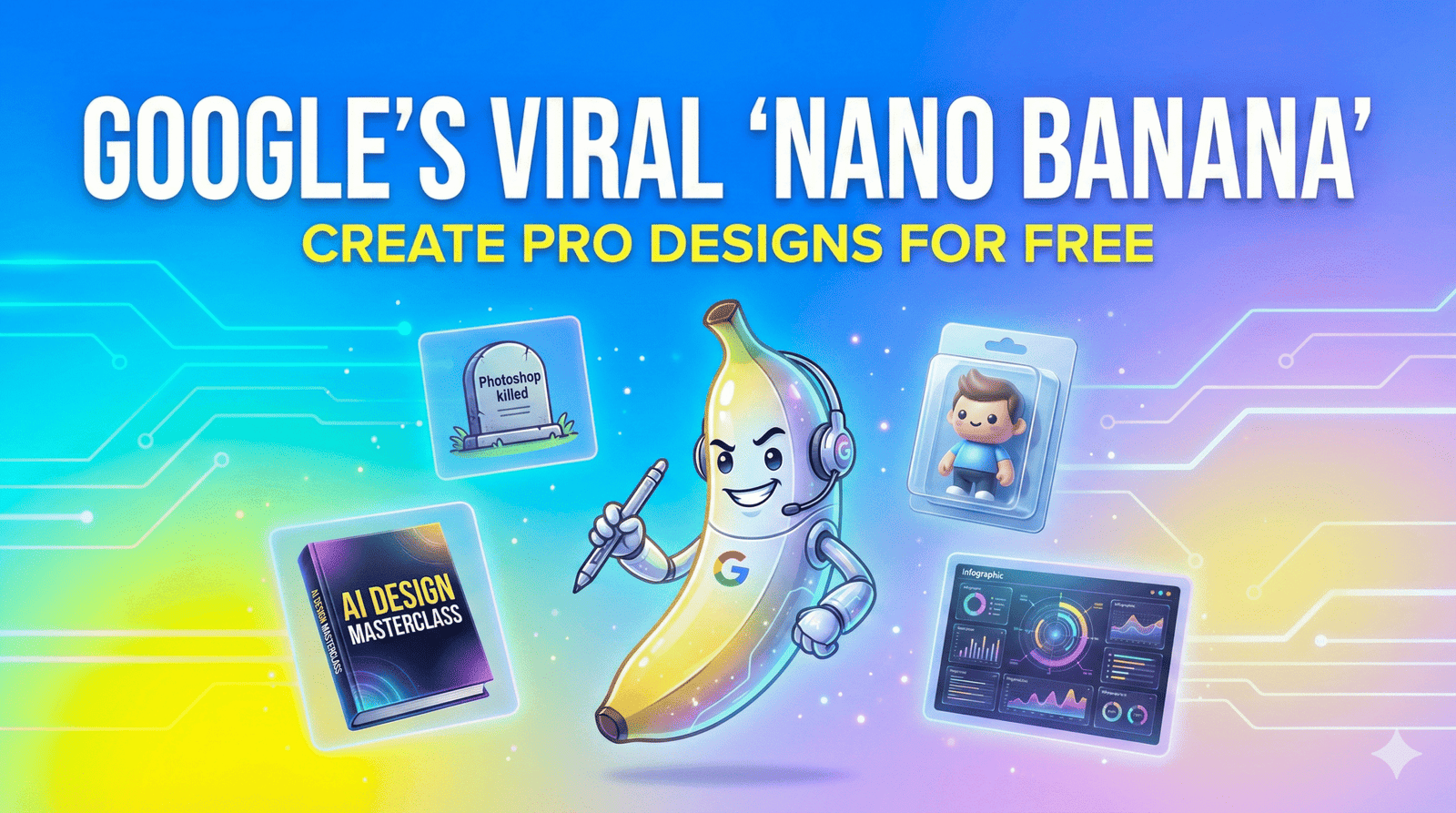
"Google Nano Banana AI tool promotional graphic featuring a cartoon banana character with headphones. Text reads: 'Google's Viral Nano Banana Create Pro Designs For Free'. Background shows examples of AI-generated assets including a 3D figurine, ebook cover, and data dashboard."

Introduction: The Day Photoshop Became “Optional”

You know that feeling. You’re staring at a blank screen, the cursor blinking mockingly at you. You have a brilliant concept for a digital product—maybe a viral ebook cover, a set of stickers, or a high-converting YouTube thumbnail—but the barrier between your brain and the screen feels insurmountable. You either have to pay a designer $500 on Upwork and wait three days, or wrestle with complex software that feels like it requires a pilot’s license to operate.

For years, we’ve been told that “AI will help,” but mostly, it just gave us six-fingered hands and text that looked like alien hieroglyphics.

Then, last week happened. A little yellow fruit emoji took over your X (formerly Twitter) feed.

It’s called Nano Banana Pro, and despite the absolutely ridiculous name, it has completely shattered the ceiling for what free tools can do. Google’s accidental viral sensation—officially powered by the terrifyingly smart Gemini 3 architecture—isn’t just another image generator. It’s a design engine that understands physics, lighting, and most importantly, human language.

If you are tired of monthly subscriptions and steep learning curves, you are in the right place. I’m going to walk you through exactly how you can use this tool to build professional-grade digital products today, for free.


What is “Nano Banana” (and Why is Everyone Posting It?)

First, let’s address the elephant—or rather, the fruit—in the room. Why is a trillion-dollar company like Google releasing a tool called “Nano Banana”?

It started as a leak. In early November 2025, an anonymous model appeared on the AI benchmark site “LMArena” under the codename nano-banana-v1. It absolutely crushed the competition, beating Midjourney v6 and Flux in blind tests. The community fell in love with the quirky name, and by the time Google officially revealed it as Gemini 3 Pro Image, the internet had already decided: it’s Nano Banana. Google, smart enough to read the room, kept the branding.

Why It’s Viral Right Now

There are two massive trends driving the obsession:

  1. The “Figurine” Mode: You’ve likely seen your friends posting 3D, vinyl-toy versions of themselves. That’s Nano Banana’s signature style, which captures likeness without hitting the “uncanny valley.”
  2. The “Thinking” Editor: Unlike older models that just slapped pixels together, this new model “thinks” before it draws. If you ask for a “reflection in a puddle,” it calculates the angle of the light.

This isn’t just a toy; it’s a paradigm shift. It connects directly to Google Search, meaning it knows what a “iPhone 17 Pro Max” looks like the day it launches, without waiting for a model update.


Step-by-Step: How to Access Nano Banana Pro for Free

You don’t need a waitlist, and currently, you don’t even need a credit card for the base tier. Here is how you get in.

The Setup Process

  1. Open the App: Navigate to the Gemini App on your phone or desktop browser.
  2. Switch Modes: By default, Gemini might use the faster, lower-quality “Flash” model. You need to look for the model toggle at the top of the chat window.
  3. Select “Thinking”: Click on the dropdown and select “Gemini Thinking (Nano Banana)”. You’ll know it’s active when you see the small yellow icon next to the prompt bar.
  4. Activate Creative Mode: Type the command /activate creative or simply start your prompt with “Generate an image of…”

Note: The free tier gives you about 50 “Pro” generations a day before throttling you back to the standard model. Use them wisely.


The “Ingredients” Recipe: Writing the Perfect Nano Banana Prompt

Most people fail at AI art because they talk to it like a robot (“Dog, sitting, 4k”). Nano Banana Pro is built on a Large Language Model (LLM), so you need to talk to it like a human art director.

To get results that look like you hired a pro agency, use this “Ingredients” framework. Think of it like cooking; you can’t just throw everything in the pot and hope for the best.

Ingredient CategoryWhat to AddExample Prompt Fragment
The Base (Subject)The main focus. Be specific about materials.“A futuristic sneaker made of translucent frosted glass and matte rubber…”
The Seasoning (Lighting)This defines the mood. Use photography terms.“…lit by softbox studio lighting with a warm rim light on the edges…”
The Garnish (Camera)Tells the AI how to “shoot” the photo.“…shot on a 35mm lens, f/1.8 aperture for a blurry background, low angle view…”
The Secret Sauce (Action)What is happening? Give it energy.“…suspended in mid-air, creating a dynamic splash of neon water droplets.”

Pro Tip: The “Secret Sauce” is where Nano Banana shines. You can add abstract concepts like “Make it look like it smells like vanilla” and the model will actually adjust the color palette to creamy whites and soft yellows to match that “vibe.”


3 Ways to Create Sellable Digital Products with Nano Banana

You aren’t here just to make pretty pictures; you want to build assets. Here are three high-value use cases you can start monetizing immediately.

1. The “Text-Perfect” Ebook Cover

For years, the biggest giveaway of AI art was the text. It would spell “Mystery” as “Mysterye.” Nano Banana Pro has solved this with OCR-level text rendering.

  • The Problem: Authors need covers that look professional but can’t afford $300 custom designs.
  • The Workflow:
    • Prompt: “A minimal thriller book cover titled ‘THE SILENT WATCHER’ in bold, distressed sans-serif font. The text should be white and centered at the top. The background is a foggy forest with a single red balloon. High contrast, professional typography.”
    • Result: You get a cover where the text is perfectly spelled and integrated into the fog—not just floating on top.
  • Monetization: Offer “Instant Kindle Covers” on Fiverr or Etsy.

2. Viral “Figurine” Avatars (The Current Trend)

This is the hottest trend on social media right now. People love seeing themselves as collectible toys.

  • How to do it: Upload a clear selfie of yourself (or your client) into the chat.
  • The Prompt: “Turn this person into a collectible 3D vinyl toy figure. Glossy plastic finish, big eyes, cute proportions. They are wearing a cyberpunk jacket. Displayed inside a plastic blister pack with a label that says ‘VIBE CODER’.”
  • Monetization: Sell “Custom Avatar” packages to streamers and influencers who want branded profile pics.

3. Infographics that Actually Make Sense

This is the killer feature for business clients. Because Nano Banana connects to Google Search, it doesn’t hallucinate facts as often.

  • The Workflow: Ask Nano Banana to “Create a vertical infographic about the ‘Benefits of Green Tea’ using real data from health websites. Use a pastel color palette and clean vector icons.”
  • Why it’s huge: It will pull real health benefits (antioxidants, brain function) and layout the text in a readable, designer-friendly format. You can sell these as “Social Media Content Packs” to health coaches.

Editing Like a Pro: The “Thinking” Edit Mode

Here is where you save money on Photoshop. Usually, if an AI image is 90% perfect but has one flaw (like a weird eye or a coffee cup floating in mid-air), you have to trash it.

With Nano Banana, you use Conversational In-Painting.

Once you generate an image, simply reply to it:

  • “Remove the sunglasses, but keep the reflection in the eyes.”
  • “Change the coffee cup to a matcha latte, and make the steam shape like a heart.”
  • “The lighting is too harsh. Change it to ‘Golden Hour’ sunset lighting.”

The model understands the 3D geometry of the scene. It won’t just paste a flat sticker of a latte on top; it will relight the latte to match the sunset you asked for. This “Physics-Aware Editing” is what sets it apart from Midjourney.


Frequently Asked Questions (FAQ)

Q: Is Nano Banana Pro actually free?

A: Yes and no. The base model is free within the Gemini app for a set number of generations per day. If you are a heavy user (generating hundreds of images), you will need the Gemini Advanced subscription. However, the free tier is generous enough for most casual creators.

Q: Can I use these images for commercial use?

A: Generally, yes. Google’s terms allow for commercial use of images generated by Gemini, but you do not own the copyright (since AI cannot hold copyright). This means you can sell the assets, but you can’t sue someone else for using them. Always check the latest Terms of Service as they update frequently.

Q: How does it compare to Midjourney v6?

A: Midjourney is still slightly more “artistic” and painterly for fantasy and abstract art. However, Nano Banana destroys Midjourney when it comes to instruction following, text rendering, and editing. If you need a specific product shot with specific text, choose Banana. If you want a dreamy oil painting, Midjourney might still have the edge.

Q: Why is it called “Nano Banana”?

A: As mentioned, it was an internal code name that leaked. The developers used fruit names for different model sizes (Nano, Micro, Macro). “Banana” was the code for the image model, and the “Nano” prefix implied it was efficient. The internet loved it, so it stayed.


Conclusion: Don’t Let the Funny Name Fool You

It might sound like a meme, but Nano Banana Pro is the most capable design tool on the market right now. It bridges the gap between “prompting” and “designing.”

For the first time, you don’t need to know how to manipulate layers, masks, or vectors. You just need to know how to describe what you want. The barrier to entry for creating professional digital products has just dropped to zero.

The only question left is: What will you create today?