
When considering your options, think about creating a faceless channel that resonates with your audience.
Embrace the concept of a faceless creator and explore unique approaches to content delivery.
Introduction: The Art of Being Seen Without Being Watched
Exploring the world of a faceless creator allows you to share ideas without personal exposure.
You know that feeling. You have a brilliant idea for a video, a story you are dying to tell, or a skill you want to teach. You open your camera app, stare at the red “Record” button, and freeze.
A faceless identity in the digital space can foster authenticity without the pressure of personal exposure.
A faceless approach can open up new channels for creativity and expression.
Suddenly, you are hyper-aware of everything. The lighting looks bad. Your background is messy. You worry about your coworkers finding your channel, or strangers on the internet judging your appearance. The anxiety creeps in, and you close the app. The idea dies right there in your camera roll.
For years, the “creator economy” felt like an exclusive club for extroverts—people who loved the spotlight and didn’t mind pointing a lens at their face every single day. If you valued your privacy, you were told you couldn’t compete.
But as we head into 2026, the script has completely flipped.
With the right strategies, a faceless approach can streamline your creative process.
The “Faceless Channel” is no longer just a niche side hustle; it is the smartest digital asset you can build. We aren’t talking about the boring, robotic “stock footage and text-to-speech” videos that flooded YouTube in 2024. We are talking about a new wave of cinema.
Consider the advantages of running a faceless YouTube channel, where your focus can remain solely on content quality.
Thanks to a suite of powerful (and free) AI tools that have matured over the last year, you can now produce documentary-level content from your bedroom without ever showing your face, revealing your identity, or buying a $2,000 camera.
You don’t need a studio. You don’t need a production team. You just need a roadmap. Here is exactly how to build a profitable faceless YouTube channel in 2026.
Step 1: Choosing a Profitable Niche for Your Faceless YouTube Channel
Before you generate a single pixel of video, you need to understand the math behind the platform. Many beginners fail because they pick a niche based on “passion” alone, without checking the revenue potential.
In the YouTube world, not all views are created equal. Advertisers pay differently depending on who is watching. This is known as CPM (Cost Per Mille, or cost per 1,000 views). A gaming channel might earn $2 per 1,000 views, while a finance channel could earn $25 for the same number of views.
Since you are building a faceless YouTube channel, you have the flexibility to choose a high-value topic without needing to be an expert “guru” on camera.
“This roadmap focuses on strategy. If you want a complete list of the software needed to execute this (from editing to analytics), read our Ultimate Content Creator Toolkit 2026.”
Top Trending Faceless Niches for 2026
1. The “Video Essayist” (High Retention)
Think about those 20-minute deep dives into “The Rise and Fall of Flappy Bird” or “Why Modern Architecture is Boring.” These videos dominate the algorithm because they tell a story.
- Why it works: You don’t need original footage; you need a good script and editing.
- Revenue potential: High, due to long watch times and mid-roll ads.
2. “Future Tech” Explainers (High CPM)
Irony is alive and well—using AI to explain AI is a massive market. Complex topics like quantum computing, space travel, or the latest LLM releases confuse the general public.
- Why it works: You act as the translator. You take complex news and turn it into digestible, visual stories.
- Revenue potential: Extremely high. Software companies are desperate to sponsor these channels.
3. Digital Zen & Ambience (High Replay Value)
This is the “set it and forget it” niche. “Cozy Coffee Shop 24/7” or “Cyberpunk Rain Sounds for Sleeping.”
- Why it works: People don’t watch these once; they loop them for 8 hours while they work or sleep.
- Revenue potential: Lower CPM, but massive volume and watch time hours.
Key Takeaway: Don’t just pick a topic. Pick a business model. If you want to replace your day job, aim for Finance, Tech, or Software Education niches where the ad revenue is substantial.
Step 2: The “Human-First” Scripting Recipe
The biggest mistake new creators make in 2026 is laziness. They go to ChatGPT, type “Write a script for a video about coffee,” and copy-paste the result.
The output is always the same: “In today’s fast-paced digital world, coffee is important…”
Viewer retention drops to zero instantly. Audiences have developed a “sixth sense” for AI writing. To win, you need to use AI as a collaborator, not a generator.
The Tool: Claude 3.5 (or latest)
While ChatGPT is great for coding, Claude has consistently proven to be the better creative writer. It understands nuance, tone, and pacing far better than its competitors.
Prompt Engineering for Retention
Stop asking for “scripts.” Ask for “stories.” Here is a prompt framework you can steal:
*”Act as a documentary filmmaker. I need a storyboard and narrative for a YouTube video about the history of the Sriracha hot sauce shortage.
The Goal: Make the viewer feel the stakes. Do not use cliché phrases like ‘In this video’ or ‘Let’s dive in.’
The Hook: Start the first 10 seconds with a surprising fact or a dramatic moment.
The Tone: Investigative, slightly humorous, and fast-paced.
Structure: Break it down into 3 acts.”*
By giving the AI a “role” (filmmaker) and setting strict constraints (no clichés), you get a script that sounds like it was written by a human.
The “Free AI Tech Stack” Ingredients
To run a successful faceless YouTube channel in 2026, you don’t need expensive monthly subscriptions to stock footage sites or hiring editors on Upwork. The tools have evolved.
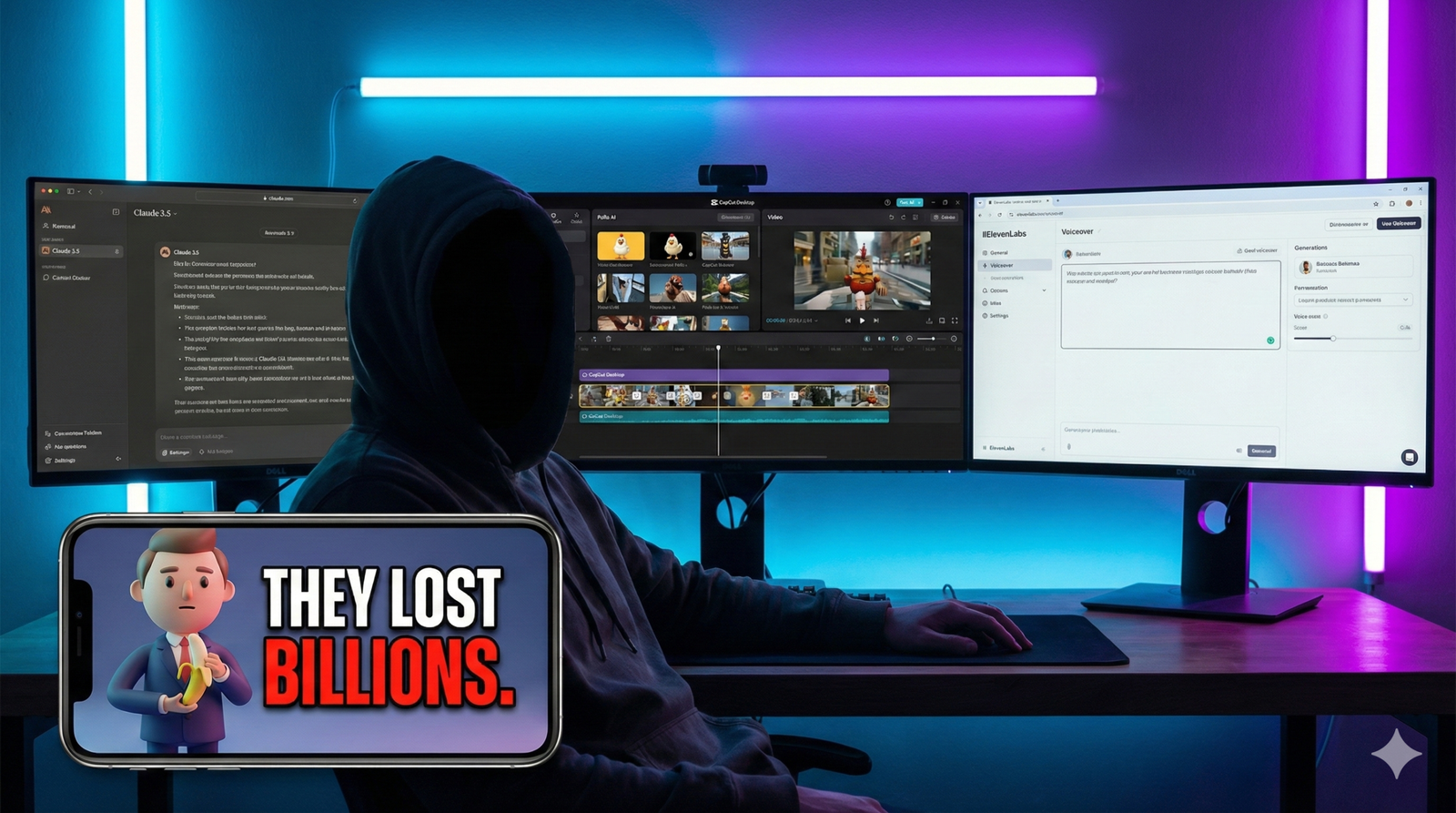
Here is the exact “recipe” of free (or freemium) tools you will use to replace an entire production team:
| Ingredient (Tool) | Role in the Process | Why It’s Essential |
| Claude / ChatGPT | The Screenwriter | Writes scripts with human pacing, avoiding the “robotic” AI tone. |
| Pollo AI / Sora | The Cinematographer | Generates unique, high-definition B-roll from text prompts. |
| ElevenLabs (Free) | The Narrator | Provides “Speech-to-Speech” for realistic inflection and emotion. |
| CapCut Desktop | The Editor | Offers auto-captions, effects, and slick transitions for free. |
| Google Nano Banana | The Thumbnail Artist | Creates high-contrast, clickable viral images (3D/Stylized). |
Step 3: Generating Cinematic Visuals (Forget Stock Footage)
In the “old days” of 2023, faceless channels relied on stock footage. You would search Pexels for “sad man” and get the same generic clip that 50 other channels were using.
In 2026, we generate our own reality.
Using video generation aggregators like Pollo AI (which taps into models like Kling or Sora), you can act as a director. If your script mentions “a futuristic city made of glass,” you don’t look for a clip of it; you create it.
How to Prompt for Consistency
The journey of building a faceless channel is filled with unique opportunities for storytelling.
The danger with AI video is that one clip looks like a cartoon and the next looks like a photograph. This jars the viewer and breaks immersion.
To fix this, establish a “Style String” in your prompts. This is a set of keywords you append to every single prompt for that video.
By utilizing AI tools, anyone can create compelling content for a faceless brand.
- Example Style String: “…shot on 35mm film, grainy texture, moody lighting, cinematic aspect ratio, photorealistic 8k.”
Your Workflow:
- Take a sentence from your script: “The company crumbled under the weight of its own debt.”
- Convert it into a visual prompt: “A crumbling stone statue of a businessman in a suit, collapsing into dust, dark grey background, [Style String].”
- Generate 3-4 seconds of video.
This results in unique, never-before-seen footage that is copyrighted by you, protecting your channel from copyright strikes.
Step 4: The Voiceover—Passing the “Human Test”
Nothing kills a channel faster than that monotone, generic “AI TikTok Voice.” You know the one. It signals to the viewer: “This is low-effort content.”
For a faceless YouTube channel in 2026, the audio needs to have soul.
The Solution: “Speech-to-Speech”
Text-to-Speech (TTS) is fine, but Speech-to-Speech (STS) is the secret weapon. This feature, available in tools like ElevenLabs, allows you to act out the script yourself—even if you have a bad microphone or a heavy accent—and the AI will “reskin” your voice.
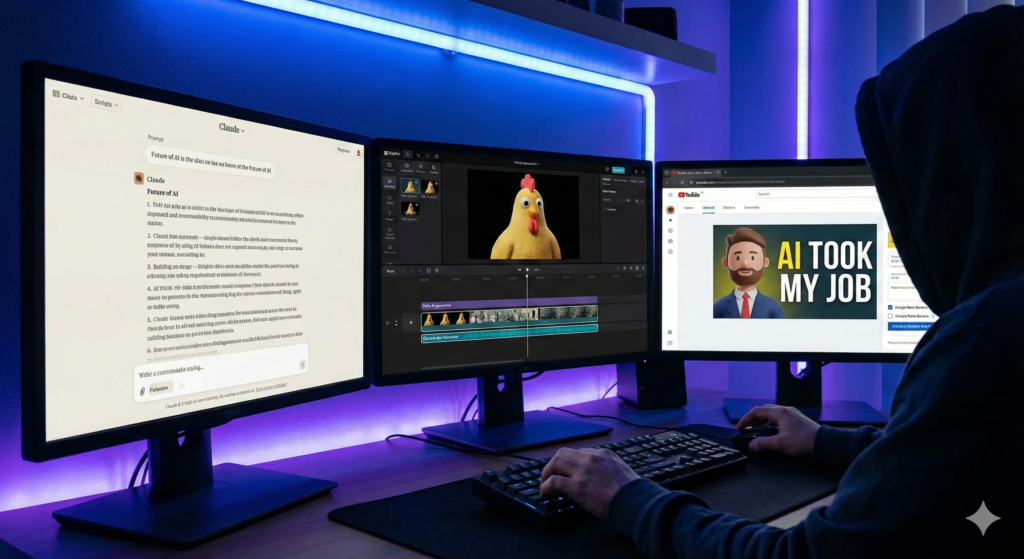
How it works:
- Record yourself reading the script into your phone’s voice memo app. Don’t worry about the audio quality; worry about the emotion. Whisper when it’s mysterious. Shout when it’s exciting. Speed up when it’s intense.
- Upload that audio file to the AI tool.
- Select a “Pro Narrator” voice.
- The AI will generate a new audio track that sounds like a professional voice actor, but it will keep your pacing, your pauses, and your intonation.
This bypasses the uncanny valley. The voice breathes. It hesitates. It feels real because the underlying performance was real.
Step 5: Packaging and Thumbnails (The Click Factor)
You can have the best script and the most beautiful AI video in the world, but if nobody clicks, the algorithm will bury you.
The thumbnail is not an afterthought; it is the most important asset.
For 2026, the trend has shifted away from “surprised faces” to “high-contrast storytelling.” You want an image that creates a “Curiosity Gap”—a gap between what the viewer knows and what they want to know.
Designing with Google’s “Nano Banana“
This is where Google’s viral tool shines. Because it understands complex spatial relationships, you can create thumbnails that look like high-budget 3D renders.
The “Rule of 3” for Thumbnails:
Don’t clutter the image. A viral thumbnail usually contains only three elements:
- The Subject: A clear, large focal point (e.g., a 3D character or object).
- The Action/Context: Something happening to the subject (e.g., it’s burning, falling, or glowing).
- The Text: Maximum 3 words. Big, bold, and readable on a phone screen.
Example Prompt for Nano Banana:
“A 3D vinyl toy figure of a hacker sitting in a dark room, glowing green screens surrounding him, looking back at the camera in fear. High contrast, saturated colors. 16:9 aspect ratio.”
Add text like “HE GOT CAUGHT” in bright yellow, and you have a click-magnet.
Frequently Asked Questions (FAQ)
Can a faceless YouTube channel actually get monetized?
Yes. There is a myth that YouTube demonetizes AI content. This is false. YouTube’s monetization policies require content to be original and add value. They strictly punish “programmatically generated” content (spam), but they welcome high-quality, story-driven content made with AI tools. You simply need to check the “Altered Content” box during upload if your content looks realistic but isn’t.
How long does it take to make a faceless video with AI?
In the past, editing a documentary could take weeks. With this AI workflow, a high-quality 8-10 minute video can be produced in 3 to 5 hours. The script takes 30 minutes, generating visuals takes 1 hour, and assembly/editing takes the rest.
Do I need a powerful PC for AI video generation?
No. This is the beauty of the 2026 ecosystem. Tools like Pollo AI, Claude, and ElevenLabs are all cloud-based. The heavy lifting is done on their servers, not your computer. You can literally run a media empire from a Chromebook, an iPad, or an older laptop.
Is it too late to start a YouTube channel in 2026?
Saturation is a myth. “Boring” content is saturated. High-quality, story-driven content is always in demand. The “faceless” niche is actually expanding because viewers are tired of influencer personalities and drama; they just want good information and good stories.
Conclusion: The Barrier to Entry Just Vanished
The era of needing a $3,000 Sony camera, a professional lighting rig, and a sound-treated studio is officially over.
The tools listed above have democratized creativity in a way we have never seen before. The only barrier left is your own willingness to start. You have the roadmap. You have the tech stack. You know the niches that pay.
A faceless YouTube channel is more than just a creative outlet; it is a vehicle for freedom. It allows you to build an audience, generate income, and share your voice without sacrificing your anonymity.
So, don’t wait for the “perfect” video idea. Don’t wait until you feel “ready.” Open Claude, generate that first script tonight, and let the AI handle the rest. Your audience is waiting to hear your story—even if they never see your face.
create a Faceless youtube channel, faceless youtube channel ideas, faceless youtube channel step, faceless youtube channels, How many views do you need to make $10,000 a month on YouTube?, Who is the most popular faceless YouTuber? Do faceless YouTube channels make money? Faceless
The freedom offered by a faceless YouTube channel allows for endless creative possibilities.