SEO is Dead. Long Live AEO: How to Rank in ChatGPT Search in 2026
Table of Contents
The “Zero-Click” Heartbreak
AEO : Do you remember the first time you felt it? That specific, sinking feeling in your stomach when you checked your analytics dashboard.
For years, you played the game perfectly. You followed every rule. You wrote the exhaustive 2,000-word guides, you painstakingly built backlinks, and you prayed to the Google algorithm gods. And for a long time, it worked. The traffic flowed. The ad revenue clicked. You felt like you understood how the internet worked.
But lately, the silence is deafening.
You look at your rankings, and they are holding steady. You are still on Page 1. Yet, the clicks are drying up. The traffic line is flattening. Why? Because your readers aren’t clicking anymore. They are asking. They are having full conversations with AI agents, getting the exact answers you worked so hard to write, without ever visiting your website.
It feels like a betrayal. It feels like the digital empire you built is crumbling foundation first.
But I am here to tell you that this isn’t the end of your story. It is simply a plot twist. The game hasn’t ended; the board has just changed shape. Traditional SEO is fading, but AEO (Answer Engine Optimization) is rising. And if you adapt your strategy right now, you won’t just survive the shift of 2026—you will own it.
What is AEO? (And Why It’s Killing Traditional SEO)
To survive this shift, you first need to understand the fundamental difference in how the world searches today compared to three years ago.
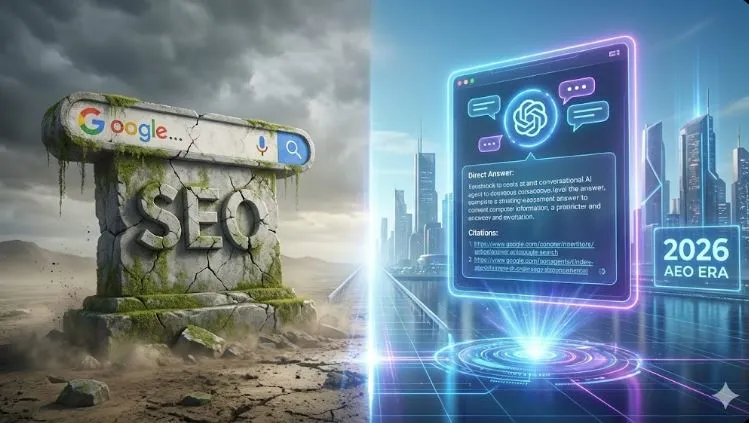
For two decades, we optimized for Search Engines (like Google). The goal of a search engine is to provide a menu. You ask a question, and Google hands you a list of links, effectively saying, “Here are ten websites; go find the answer yourself.”
Today, we are optimizing for Answer Engines (like ChatGPT, Perplexity, and Google’s AI Overviews). The goal of an answer engine is to provide a meal. The user asks a question, and the AI reads ten websites in a millisecond, synthesizes the information, and hands the user the direct answer.
The Data Doesn’t Lie
We are seeing a massive shift toward “Zero-Click Searches.” By early 2026, industry data suggests that over 40% of informational queries are being handled by AI agents without the user ever clicking a blue link.
If your entire business model relies on someone clicking a link to read a definition, you are in trouble. But here is the opportunity: AI models need sources. They need data to train on and to cite. The goal of AEO is no longer to be “Result #1” on a page of links. The goal is to be the Primary Citation—the trusted source the AI uses to construct its answer.
The Anatomy of an AI-Friendly Post
If you want to be that citation, you have to stop writing for humans who like to skim, and start writing for machines that need data. AI models hate fluff. They struggle with nuance, sarcasm, and buried leads. They crave structure.
This brings us to the most important rule of AEO: The Inverted Pyramid.
In the old days of blogging, you wanted to keep the user on the page as long as possible (dwell time). So, you buried the answer at the bottom. You wrote long, winding introductions about your childhood to pad the word count.
Why “Storytime” Intros Are Dead If you write a recipe post in 2026 and start with a 500-word story about your grandmother’s apple orchard, the AI will ignore you. It considers that “noise.” It will move to your competitor’s site, which lists the ingredients in the first paragraph, and cite them instead.
To rank in ChatGPT Search, you must give the answer immediately—in the first 50 words—and then use the rest of the article to add context, nuance, and examples.
The “AEO Ranking Recipe”: Essential Ingredients
Think of your content as a database entry. If the data is messy, the AI can’t read it. If the data is clean, structured, and labelled, the AI will prefer it every time.
Below is the exact “recipe” you need to follow for every single blog post you publish from today onward.
Table: The Perfect AEO Optimization Recipe
| Ingredient | Amount | Function |
| Direct Answer | 50 Words (Max) | The specific, concise answer to the user’s question. Place this directly under your H1 or H2. |
| Structured Data | Schema.org Markup | JSON-LD code that tells the AI exactly what the content is (e.g., FAQ, Recipe, How-To). |
| Authority Statistics | 2-3 Cited Sources | AI trusts numbers. Use proprietary data or cite reputable studies to back up your claims so the AI verifies you as “fact.” |
| Conversational Tone | Natural Language | Write like you speak. AI matches user intent, which is usually conversational (e.g., “How do I fix this?”). |
| List Formatting | Bullet Points | AI parses lists faster than paragraphs. Break complex ideas down into steps. |
Export to Sheets
How to Structure Your Content for “Citations”
In the AEO economy, a backlink is nice, but a “citation” is currency. A citation happens when ChatGPT says, “According to eBookTreasures, the best way to…”
How do you force the AI to cite you? You use Entity-Based SEO.
Search engines used to look for keywords (strings of text). Answer engines look for Entities (concepts and relationships). If you want to rank for “Best Content Tools,” you can’t just repeat that phrase. You need to map out the entities related to it: “Video Editing,” “Productivity,” “Automation,” “Software Cost.”
The Q&A Strategy
The easiest way to implement this is to turn your headers into specific questions.
- Use a tool like AnswerThePublic or look at the “People Also Ask” box in Google to find specific questions your audience is shouting into their phones.
- Make those questions your H2s.
- Provide the Direct Answer immediately under the header.
Bad H2: Understanding The Nuances of Camera Aperture AEO H2: What is the Best Aperture for Portraits? The Answer: The best aperture for portraits is typically between f/1.8 and f/2.8. This creates a shallow depth of field that blurs the background while keeping the subject sharp.
See the difference? The second example is “machine-readable.” It is a direct question and a direct answer.
Tools You Need to Win the AEO War
You cannot fight this war manually. The sheer volume of content required to become a topical authority means you need a tech stack that works as hard as you do.
Rank Math Pro
We have mentioned this before, but it bears repeating. You need an SEO plugin that understands the AI era. Rank Math’s new features, specifically the ability to generate llms.txt files and advanced Schema markup, are non-negotiable. This plugin effectively translates your human writing into robot language.
Specialized AI Writing Assistants
Here is the catch: You can’t just ask ChatGPT to “write a blog post.” It will give you generic, unoptimized fluff that won’t rank in its own search engine.
To win, you need to “program” your AI writer. You need specific prompts that force the AI to use the Inverted Pyramid, to add data tables, and to structure for citations.
- Pro Tip: Don’t rely on default prompts. If you want to speed up your workflow, check out our SEO Blog Post Prompts in the shop. We designed these specifically to format articles for AEO, saving you hours of formatting time.
🚀 fast-track your ranking
You could spend hours trying to figure out the right commands to give ChatGPT… or you could just copy mine.
I’ve packaged my Top 10 AEO-Engineered Prompts (including the “Zero-Click Analyzer” and “Schema Generator”) into a simple copy-paste bundle.
Stop guessing. Start ranking.
👉 Download the AEO Ranking Prompt Bundle ($1.99)
Frequently Asked Questions about AEO (FAQ)
Note: This section is crucial. By formatting these as an FAQ with Schema markup, you increase your chances of being featured in voice search results.
Is SEO completely dead in 2026?
No, traditional SEO is not dead. “Transactional” searches (like “Buy Nike shoes size 10”) still happen on Google and Amazon. However, “Informational” SEO (like “How to clean running shoes”) is rapidly moving to Answer Engines. You need a hybrid strategy to capture both.
How do I track AEO traffic?
This is tricky because AI agents don’t always leave a cookie. You need to look beyond “Organic Search” in your analytics. Monitor your “Direct” traffic and “Referral” traffic from sources like OpenAI, Perplexity, and Bing Chat. These are often the footprints of AI users finding you.
What is the most important factor for AEO ranking?
Authority and Clarity. The AI must trust your domain (Authority), and it must be able to parse your answer easily (Clarity). If your site is slow, cluttered with pop-ups, or written in confusing academic language, the AI will bypass you.
Conclusion
The horizon hasn’t disappeared; it has just expanded.
The creators who cling to the old ways—the keyword stuffers, the recipe bloggers with 10-page life stories, the click-baiters—they are going to vanish. They are optimizing for a machine that is slowly being turned off.
But you? You are building a library of answers. By shifting to AEO, you are positioning yourself as the expert in the room. You are becoming the trusted voice that the AI relies on to make sense of the world.
Don’t fear the machine. Feed it. Optimize your content for the answer engine, provide undeniable value upfront, and you will find that while the cheap “click” might be dead, your influence is stronger than ever.
Ready to future-proof your content? Don’t leave your rankings to chance. Download our SEO Blog Post Prompts today and start structuring every single article for the AEO era. The future is already here—make sure you are written into it.