What Is a Digital Creator — And Why Everyone Seems to Be Becoming One in 2026
From Facebook labels to full-time income: the honest guide to understanding the creator economy and finding your place in it.
Table of Contents
✦ Key Takeaways
- A digital creator is anyone who produces online content — videos, posts, newsletters, art — that provides value to an audience.
- Income varies wildly: most beginners earn little, but established creators can make thousands monthly through multiple streams.
- The “Digital Creator” label on Facebook is a real feature that unlocks monetization tools and signals you’re posting publicly.
- You don’t need millions of followers. Niche audiences and multiple revenue streams matter far more.
- Getting started is less about talent and more about consistency and choosing the right platform for your content type.
Here’s a question that, honestly, more people are Googling than you’d expect: What exactly is a digital creator? Maybe you spotted the phrase on someone’s Facebook profile and wondered if it was a job, a status symbol, or just what people call themselves when they spend a lot of time online.
The truth is, it’s all three — and none of them. Let me explain what’s really going on.
So, What Does “Digital Creator” Actually Mean?
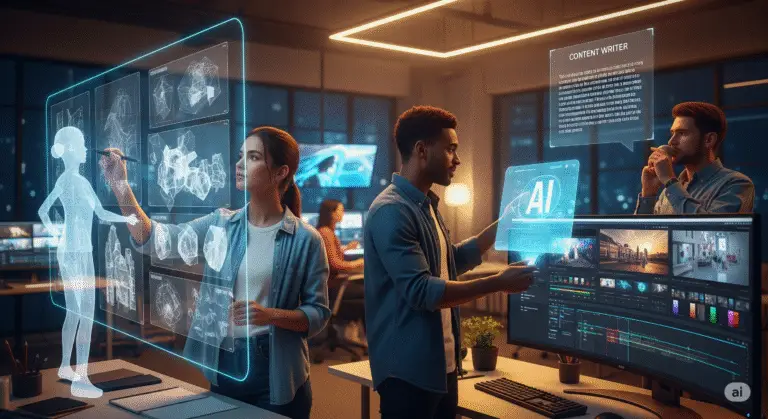
At its core, a digital creator is someone who makes content for online audiences. That content could be YouTube videos, TikToks, blog posts, Instagram Reels, podcasts, newsletters, photography, digital art — you name it. If you’re producing something of value and putting it on the internet, you’re creating digitally.
What separates a digital creator from someone who just posts on social media is intent and consistency. A creator approaches their content with a strategy: they’re building an audience, providing something valuable, and usually (though not always) trying to generate some income from it.
Think of it this way: a chef who shares recipes on YouTube isn’t just an amateur food blogger — they’re a digital creator who happens to know a lot about cooking.
“The platform doesn’t make you a creator. The habit of showing up and creating does.”
What Do Digital Creators Actually Do for a Living?
This is where it gets interesting — and where a lot of people’s curiosity really lives. The follow-up questions people search most often aren’t philosophical. They’re practical: How do these people make money?
Creators earn through a surprisingly diverse mix of revenue streams:
Ad Revenue
YouTube and TikTok pay creators based on views — but the rates differ dramatically by platform and niche.
Memberships
Platforms like Patreon let fans pay monthly for exclusive content, behind-the-scenes access, or early releases.
Sponsorships
Brands pay creators to mention or review products — often the biggest income source for mid-size creators.
Digital Products
Courses, templates, e-books, presets — things you make once and sell repeatedly.
Let’s Talk Numbers — How Much Do Digital Creators Earn?
People want specifics here, and I respect that. So let’s be real about what the numbers actually look like.
$0.01–0.03YouTube’s avg. revenue per view (RPM varies widely by niche)
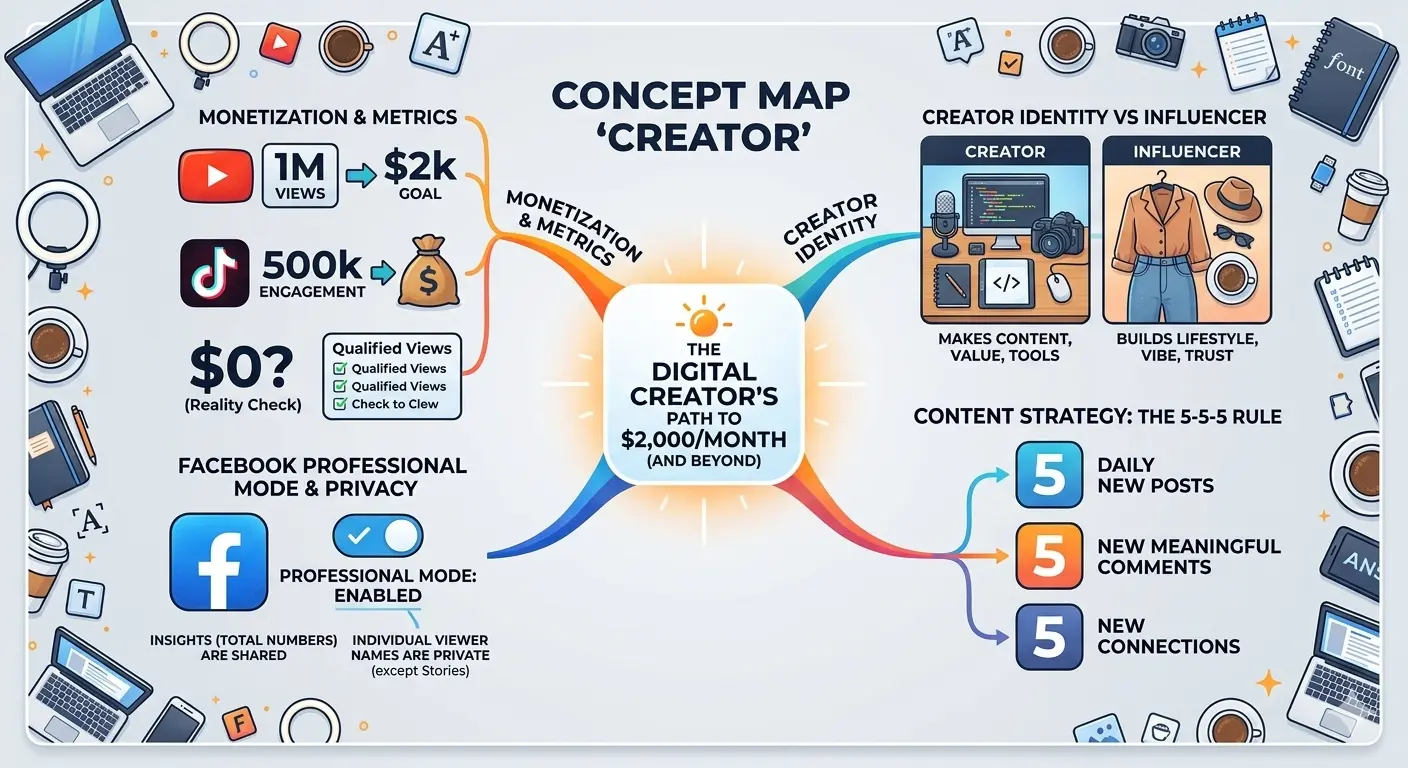
~1MYouTube views needed to earn roughly $2,000/month from ads alone
$0.02–0.04TikTok pays per 1,000 views — far lower than YouTube
Those numbers might seem discouraging at first. But here’s the thing most creator income guides miss: ad revenue is rarely a creator’s main income. The smartest creators treat platform payouts as a bonus, not a business model. Their real income comes from sponsorships, selling their own products, and community memberships.
A creator with 50,000 engaged YouTube subscribers and a well-placed online course can out-earn someone with 500,000 subscribers who relies purely on ads. Audience quality beats audience size — almost every time.
What Does “Digital Creator” Mean on Facebook?
Ah, this one. If you’ve noticed that some people’s Facebook profiles say “Digital Creator” instead of a job title or location, you’ve hit on one of the most commonly Googled questions in this whole space.
Here’s what’s actually happening: Facebook allows users to set a “professional mode” on their personal profiles, at which point they can label themselves as a Digital Creator. This unlocks several things:
- Access to Facebook’s Creator Studio tools and analytics
- The ability to monetize content through in-stream ads and Stars (Facebook’s tip system)
- A public follower count, separate from friends
- Increased reach for public posts beyond your friend list
So is a “Digital Creator” on Facebook a real person? Yes, always — it’s just a person who has switched their profile to public content mode. It doesn’t verify expertise, follower count, or income. Anyone can do it. And increasingly, people are doing it either to access monetization features or simply to signal that they’re posting publicly rather than just for friends.
One thing worth knowing: when someone has professional mode on, people can follow them without being friends. So yes — your follows and profile views can be seen, at least in aggregate.
How Do You Actually Become a Digital Creator?
This is the part that trips most people up, because the internet will tell you a hundred different things. Let me give you the version that actually works.
Step 1: Pick a niche, not a platform
The biggest mistake aspiring creators make is starting with “I want to be a YouTuber” instead of “I want to help people learn to cook budget meals.” The platform is secondary. Your subject matter — and the specific audience you want to serve — comes first.
Step 2: Choose one platform to start
Once you know what you’re creating, pick the platform where that content lives naturally. Long-form education? YouTube. Visual lifestyle? Instagram or TikTok. Written insights? Substack or LinkedIn. Trying to be everywhere at once is the fastest route to burning out with nothing to show for it.
Step 3: Learn the 5-5-5 rule for social media
You may have heard of this. The idea is simple: for every post that promotes your work, you should create five posts that educate, five that entertain, and five that engage your community. It keeps your feed from feeling like a billboard — and algorithms reward it.
Step 4: Don’t wait to feel “ready”
Every creator you admire started with terrible content. The only thing that separates them from people who never started is that they published anyway. Your first ten pieces of content are practice, not portfolio. Get them done.
What Qualifies You as a Digital Creator?
Here’s the honest answer: nothing official. There’s no exam, no certification, no follower threshold. You become a creator when you decide to create consistently and put it out into the world.
That said, what separates hobbyists from creators who build real audiences comes down to a few things: a consistent publishing schedule, a defined point of view, and a genuine understanding of who you’re making content for.
“You don’t find your niche. You make content until your niche finds you — and then you lean into it.”
The No. 1 Mistake People Make When Starting Out
Chasing income before audience. It’s understandable — everyone wants to know how to make $500 a day on Facebook or $10,000 a month on YouTube. But those results are almost always the product of years of consistent work, not a hack or shortcut.
The creators who get there fastest are almost never the ones who optimized for money first. They’re the ones who got genuinely good at something, built an audience that trusted them, and then let the monetization follow naturally from that trust.
That might sound slow. But it’s also the only way that actually works.
FAQ
What is the difference between a “Digital Creator” and an “Influencer”?
No — and this is one of the biggest myths in the creator space. A creator with 5,000 highly engaged followers in a specific niche can out-earn someone with 500,000 passive followers. What matters is trust and relevance. A fitness creator with 8,000 dedicated subscribers can sell a $97 workout program to even 2% of their audience and generate over $15,000. Focus on depth, not breadth, especially when you’re starting out.
What’s the difference between a digital creator and an influencer?
The lines blur, but here’s a useful way to think about it: influencers primarily leverage their personal brand and lifestyle to drive purchasing decisions — they influence. Digital creators primarily make content that entertains, educates, or solves problems — the audience relationship comes from the value of the content itself, not necessarily from admiring the person’s life. In practice, many successful creators are both. But “creator” thinking tends to age better because the content has value independent of you.
How long does it realistically take to earn $2,000/month as a creator?
Honest answer: for most people, 12–24 months of consistent effort. That assumes you’re posting regularly (at least once or twice a week), you’re in a niche with some monetization potential, and you’re diversifying income beyond just ad revenue. Some creators get there faster with viral content or an existing audience. Many take longer. The ones who quit at month six almost never find out what month eighteen would have looked like.
Can someone tell if I’ve been looking at their Facebook creator profile?
No. Facebook does not notify users when someone views their profile, whether they’re a Digital Creator or not. Creators with professional mode can see aggregate analytics — things like how many people their posts reached or how many profile visits they got — but they cannot see who specifically visited. So feel free to browse without worry.
What is the No. 1 money-earning app for creators right now?
There’s no single answer — it genuinely depends on your content type and audience. YouTube remains the strongest for long-term ad revenue because its content is searchable and evergreen. TikTok pays less per view but can grow audiences faster. Instagram works well for brand deals. Substack and Patreon are tops for direct audience support. The smartest move is to build on one platform, then use it to drive your audience to something you own — like an email list — where no algorithm can cut you off.
What officially qualifies you as a digital creator?
Nothing official — and that’s actually the beauty of it. There’s no license, certification, or follower threshold. You become a digital creator the moment you start creating content consistently for an audience. Platforms may have specific requirements to unlock monetization features (YouTube requires 1,000 subscribers and 4,000 watch hours for the Partner Program, for instance), but the identity of “creator” belongs to you from day one.