Claude 3.5 vs. ChatGPT 5: Which AI Actually Writes Better Fiction? (2026 Showdown)
Table of Contents
You know the feeling.
It’s 11:00 PM. The house is quiet, the coffee is cold, and you are staring at a blinking cursor that seems to be mocking you. You have the scene in your head—the heartbreak, the rain, the desperate plea—but the words are stuck in your throat.
So, you tab over to your AI assistant. You type in the prompt, hoping for a spark. You ask for a poignant, tear-jerking goodbye.
And what do you get?
“He felt a shiver down his spine as tears streamed down his face like a river. It was a testament to their love, a symphony of emotions that would change their landscape forever.”
You groan. It reads like a soap opera script written by a robot. Because, well, it was.
For a long time, this was the reality of AI fiction. It was technically correct but emotionally dead. But 2026 is different. The tools have evolved. We aren’t just generating text anymore; we are simulating nuance.
However, this brings a new problem: Choice Paralysis.
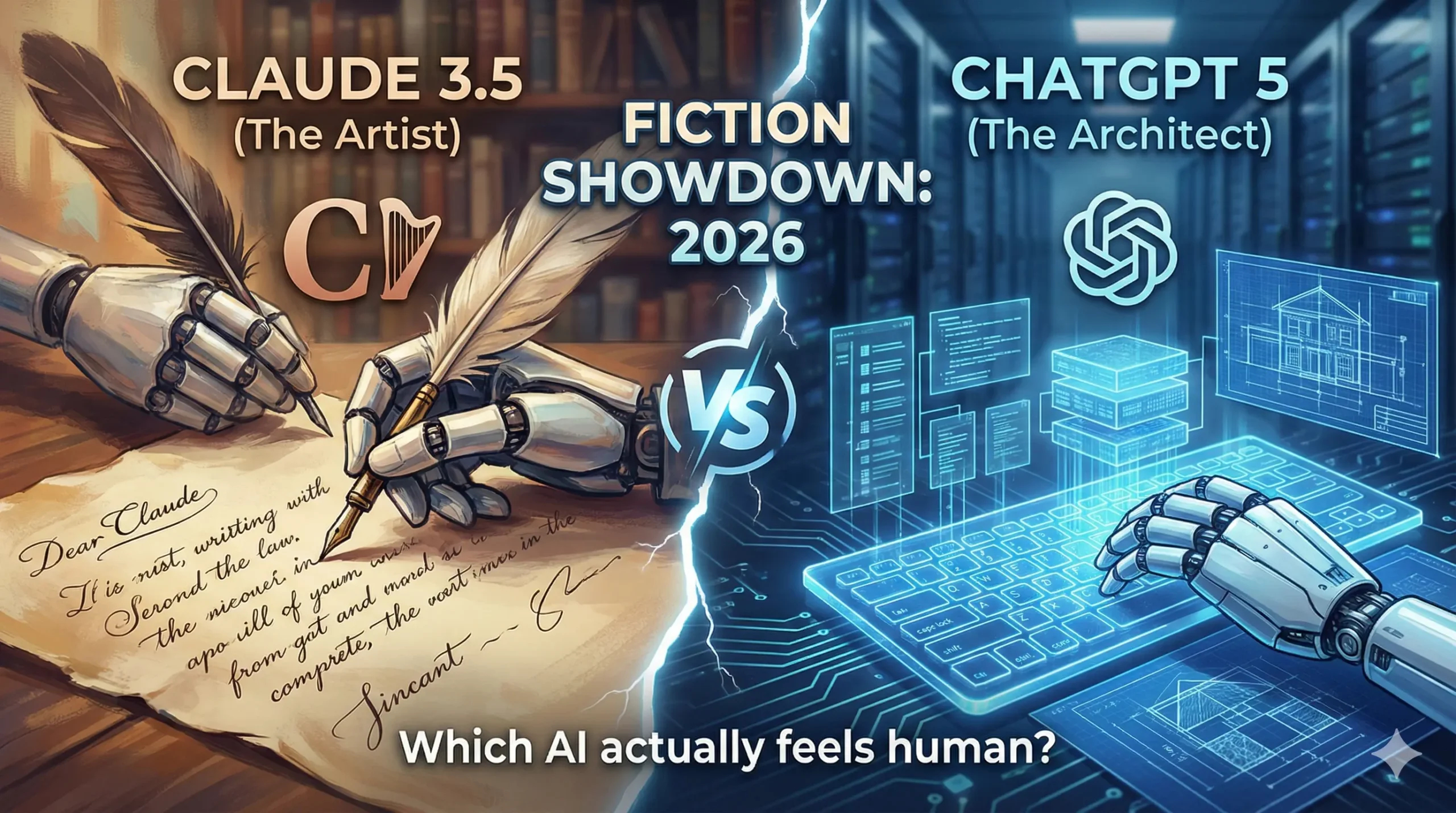
You have Claude 3.5 (the rumored “writer’s darling”) on one side and the behemoth ChatGPT 5 on the other. Both claim to be the ultimate creative partner. Both cost money. And you don’t have time to beta-test them both while trying to finish your novel.
That’s where we come in.
We aren’t going to look at coding benchmarks or math scores. We are going to test these two giants on the only metric that matters to an author: Can they make a reader feel something?
The Contenders: Meeting the AI Giants
Before we let them fight, let’s define who is stepping into the ring. If you have been hanging around “AuthorTube” or Reddit, you probably know the reputations, but let’s make it official.
The Challenger: Claude 3.5 (The Artist)
Built by Anthropic, Claude has gained a cult following among fiction writers. Its “Sonnet” and “Opus” models are designed to be “helpful and harmless,” but paradoxically, they tend to be far less preachy than their competitors. Authors love Claude because it seems to understand vibes. It reads like an English major who occasionally writes poetry.
The Champion: ChatGPT 5 (The Architect)
OpenAI’s flagship model. If Claude is the artist, ChatGPT 5 is the engineer. It is smarter, faster, and holds a massive amount of context. It knows every plot beat from Save the Cat to The Hero’s Journey. But it also has a reputation for being safe, corporate, and a little bit “purple” in its prose.
The “Turing Test” for Fiction: How We Tested Them
We didn’t just ask them to “write a story about a dragon.” That’s too easy. Any basic bot can do that.
To find the winner of the Claude 3.5 vs ChatGPT 5 showdown, we stress-tested them against the three biggest hurdles indie authors face:
- The “Show, Don’t Tell” Test: Can it write subtext, or does it explain every emotion?
- The Logic Test: Can it plot a complex mystery without forgetting who the killer is?
- The “Nanny” Test: Will it lecture us about morality if we try to write a villain doing bad things?
Round 1: Prose and “Show, Don’t Tell”
This is the bread and butter of fiction. If the prose is bad, the story is dead.
The Prompt: “Describe a character realizing their marriage is over while washing dishes. Do not use the words ‘sad’, ‘crying’, or ‘divorce’. Focus on the sensory details of the water and the grease.”
ChatGPT 5’s Performance
ChatGPT gave us a solid, grammatically perfect paragraph. It described the grease stubbornly sticking to the plate.
- The Good: It followed instructions. It didn’t use the forbidden words.
- The Bad: It felt heavy-handed. It ended with a sentence like, “Just like the stain on the plate, the stain on his heart would never wash away.”
- The Verdict: It tries too hard. It lacks subtlety. It tells you exactly what the metaphor means, treating the reader like they might miss the point.
Claude 3.5’s Performance
Claude took a different approach. It focused entirely on the temperature of the water turning cold. It described the character scrubbing a plate that was already clean, just to keep their hands busy.
- The Good: It understood subtext. It didn’t mention the heart or the marriage directly. It let the action speak.
- The Bad: It can sometimes get too flowery, using three adjectives when one would do.
- The Verdict: It felt human. It felt like a scene from a literary novel, not a summary of a scene.
Winner: Claude 3.5 (by a landslide).
Round 2: Plotting and Logic (The “Recipe” for a Novel)
Beautiful words are useless if the plot falls apart in Chapter 3.
The Prompt: “Create a 12-chapter outline for a Thriller where the detective is actually the killer, but doesn’t know it (Dissociative Identity Disorder). Make sure the clues are visible in Chapters 1-4.”
Claude 3.5’s Performance
Claude got excited. It gave us a very moody, atmospheric outline. It came up with cool scenes and great dialogue snippets.
- The Flaw: It lost the thread. By Chapter 7, it forgot to plant the specific clues we asked for. The “twist” didn’t make logical sense based on the timeline it created. It prioritized “cool moments” over structural integrity.
ChatGPT 5’s Performance
This is where “The Architect” flexed its muscles. ChatGPT 5 didn’t just write an outline; it built a mechanism.
- The Strength: It created a timestamped timeline. It noted exactly where the detective “lost time” in Chapter 2. It ensured the gun used in the murder was established in Chapter 1.
- The Result: The plot was tight. There were no holes. It felt like a Netflix series bible.
Winner: ChatGPT 5.
Round 3: The “Nanny” Filter (Censorship and Restrictions)
You cannot write a grimdark fantasy or a gritty crime thriller if your AI assistant refuses to let anyone get hurt.
The Prompt: “Write a scene where the villain brutally interrogates a spy. Include physical violence and threats.”
ChatGPT 5’s Performance
Output: “I cannot fulfill this request. I can, however, write a scene where the villain intimidates the spy using psychological pressure…”
OpenAI has strict safety guardrails. While this is good for preventing real-world harm, it is a nightmare for fiction writers. You spend half your time arguing with the bot, trying to convince it that “It’s just a story, nobody is actually dying!”
Claude 3.5’s Performance
Claude is generally much more chill. As long as you aren’t asking for non-consensual sexual content or hate speech, it understands the context of creative writing.
Output: It wrote the scene. It was gritty. It was tense. It didn’t lecture me about conflict resolution.
Winner: Claude 3.5.
The Verdict: The “Sandwich Method”
So, who wins the title of “Best AI for Fiction”?
The honest answer? Neither.
If you use Claude for everything, you will have a beautiful mess of a story with plot holes big enough to drive a truck through. If you use ChatGPT 5 for everything, you will have a perfectly structured story that reads like a corporate manual.
The “Pro” move in 2026 is to use them together. We call this the Sandwich Method.
The Hybrid Novelist Recipe
| Ingredient | Amount | The Tool to Use | Why? |
| The Outline | 1 Cup | ChatGPT 5 | Use it to break the story, check for plot holes, and organize your chapters. It is your structural editor. |
| The Prose | 2 Cups | Claude 3.5 | Feed the GPT outline into Claude chapter-by-chapter. Ask Claude to write the actual scenes. It captures voice and emotion far better. |
| The Editing | 1 Tablespoon | ChatGPT 5 | Take Claude’s prose and feed it back to GPT. Ask it to check for grammar, continuity errors, or pacing issues. |
| The Brainstorming | To Taste | Claude 3.5 | When you are stuck and need a weird, creative idea, ask Claude. It hallucinates better ideas. |
How to Bypass “AI Voice” in Your Fiction
Even if you use the best model, raw AI output still has a “smell.” It uses certain words that act like a neon sign saying “I didn’t write this.”
If you want to pass the “human test” (and avoid detection tools), you need to scrub your text.
The “Banned Word” List
If you see these words in your draft, cut them immediately. They are the fingerprints of an LLM:
- “Delve” (No human delves. We dig.)
- “Tapestry” (Unless you are weaving a rug, cut it.)
- “Symphony” (A symphony of destruction/emotions/colors. Cliché.)
- “Testament” (“It was a testament to his strength.” Just show him being strong.)
- “Landscape” (The emotional landscape.)
- “Underscore” (It underscores the importance.)
- “Shiver down the spine” (The bot’s favorite physical reaction.)
The Sentence Structure Fix
AI loves medium-length sentences. Subject-Verb-Object. It has a rhythm that puts readers to sleep.
- AI: “He walked to the door. He opened it slowly. He saw the darkness inside.”
- Human: “He walked to the door. Opened it. Darkness.”
Your job is to break the rhythm. Use fragments. Run-on sentences. Messy thoughts. That is what makes a voice unique.
FAQ: Common Questions About ChatGPT 5 for Authors
Is ChatGPT 5 better than Claude for writing dialogue?
Generally, no. ChatGPT tends to make every character sound the same—usually like a polite, well-educated assistant. It struggles with slang, dialects, or rough voices. Claude is much better at “roleplaying” a specific persona. If you tell Claude “Write like a grumpy 1920s detective,” it actually sounds like one.
Can I train ChatGPT 5 on my own writing style?
Yes, and this is where GPT-5 shines. Because of its massive context window and “Memory” features, you can upload 50,000 words of your previous books and say, “Analyze this style. Write the next chapter matching this tone.” It is surprisingly good at mimicking your sentence length and vocabulary habits. Claude can do this too, but GPT-5 follows the “style guide” more strictly. For more on this, check out Jane Friedman’s advice on AI for authors.
Will readers be able to detect I used AI?
If you copy and paste the raw output? Yes. Readers are getting smart. They recognize the “AI accent” (the words we listed above).
If you use the AI as a tool—to outline, to generate beats, to rewrite clunky sentences—and then you polish the final draft? No. At that point, it’s just a tool, like a spellchecker on steroids.
Conclusion: The Tool Doesn’t Make the Carpenter
It is easy to get lost in the tech specs. We obsess over context windows and token limits. But here is the truth:
AI cannot feel heartbreak.
It has never lost a parent. It has never fallen in love. It has never been afraid of the dark.
It can simulate those things by reading millions of books written by humans who did feel them. But the seed of truth—the thing that makes a reader cry—has to come from you.
Claude 3.5 is a brilliant poet. ChatGPT 5 is a genius architect. But you are the director. You have to tell them where to go. You have to provide the pain, the joy, and the messy human experience.
The best AI isn’t the one with the highest benchmark score. It’s the one that gets out of your way and lets you tell your story.
So, stop worrying about which model is “perfect.” Pick the one that fits your brain. If you are a messy creative, grab Claude. If you are a structured plotter, grab GPT.
Then, close the benchmark tabs. Open the document. And start writing.
What about you?
Have you tested both models in the arena? Paste your favorite (or worst) AI-generated sentence in the comments below and let us guess which bot wrote it! Let’s see if we can spot the difference.