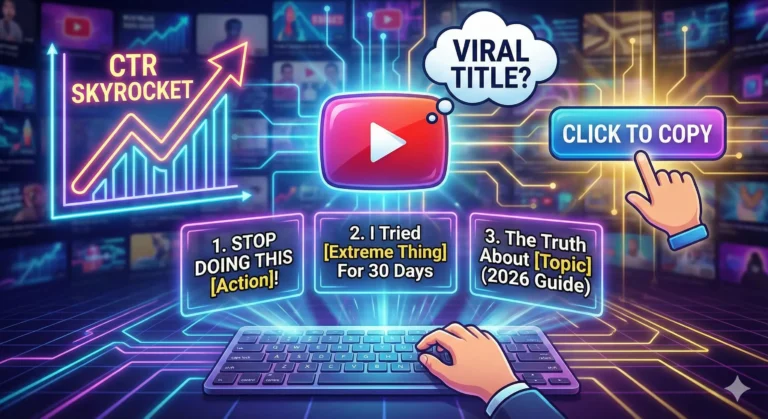

How to Generate 50 Click-Worthy Blog Titles in 1 Minute with AI
Table of Contents
It is 9:00 PM. The house is finally quiet. You have your coffee (or maybe it’s cold by now), and you are sitting in front of your laptop. You have done the hard part—or so you thought. The research is done. The outline is ready. You know exactly what you want to say about your topic.
But the cursor is just blinking at you.
You type a headline. Delete. You type another one. Delete. You stare at the empty white space at the top of your document, feeling that creeping anxiety that maybe, just maybe, nobody is going to read this hard work because you can’t figure out what to call it.
We have all been there. It is the writer’s specific brand of paralysis. You know that a bad title renders the best article invisible, and that pressure can be paralyzing.
But what if you had a brainstorming partner who never got tired? What if you could sip that coffee and watch a digital assistant spit out 50 distinct, creative, and optimized options before you could even find your mouse? This isn’t about letting a robot do your thinking; it’s about survival in the content game. It’s about leveraging technology to get past the “blank page” hurdle so you can focus on the magic only you can create.
Here is how you can stop staring at the cursor and start generating click-worthy headlines in seconds.

+4,500 Premium Fonts Vol 1
Stop searching for the perfect font and start designing with a collection that gives you all the creative freedom you need, right at your fingertips. 🤩 Add this essential “A” font bundle to your cart today and give your work a head start! 🛒
Why Your Blog Title Matters More Than the Content
You might have written the most insightful, life-changing article on the internet. But if the sign on the door is boring, nobody is walking in.
There is an old adage in the copywriting world, often attributed to advertising legend David Ogilvy: On average, five times as many people read the headline as read the body copy. This is often called the 80/20 rule. 80% of your visitors will read the headline, but only 20% will actually click through to finish the article.
In the modern era of infinite scrolling, TikTok attention spans, and crowded search results, that statistic is probably even more brutal.
The SEO Reality Check
Beyond human psychology, there is the algorithmic reality. Your blog title (often functioning as your H1 and Title Tag) is the primary signal you send to search engines. It tells Google exactly what your page is about. If your title is vague, Google gets confused. If Google gets confused, you don’t rank.
A mediocre post with a brilliant, keyword-rich title will almost always outperform a masterpiece with a vague, “clever” title. Your title has two jobs, and it must do them simultaneously:
- Hook the Human: Invoke curiosity, urgency, or benefit.
- Feed the Bot: Clearly state the topic and keyword relevance.
If you fail at either, the content dies in the dark. That is why using AI to generate volume—giving you options you might not have thought of—is a strategic superpower.
The “Secret Recipe” for the Perfect AI Prompt
Most people fail with AI for one simple reason: they are lazy with their requests. If you open ChatGPT and type, “Write me catchy titles about baking,” you will get generic, boring results. You will get “The Joys of Baking” or “How to Bake.”
To get 50 usable, high-converting titles, you need to treat the AI like a junior copywriter. You have to give it a brief. You need to feed it the right ingredients.
Think of your prompt as a recipe. If you leave out the salt, the bread tastes like cardboard. If you leave out the constraints in a prompt, the output feels robotic.
The Ultimate Blog Title Prompt Ingredients
Here is the exact breakdown of what you need to include in your request to get professional-grade results.
| Ingredient | Quantity/Type | Why It Matters |
| Topic | 1 Specific Subject | Gives the AI a clear focus (e.g., “Vegan Baking” instead of just “Food”). |
| Target Audience | 1 Defined Persona | Ensures the language resonates (e.g., “Busy Moms” vs. “Professional Chefs”). |
| Primary Keyword | 1 Main SEO Term | Essential for search ranking (e.g., “Gluten-free cookies”). |
| Tones of Voice | 3 Distinct Styles | Provides variety. If you only ask for one tone, you get repetitive results. (e.g., Witty, Urgent, Educational). |
| Formatting Rules | 2 Constraints | Keeps titles concise and usable (e.g., “Under 60 characters,” “Use numbers”). |
When you combine these elements, you force the AI to think laterally. You stop it from being generic and force it to be specific to your needs.
Step-by-Step: Generating 50 Titles in 60 Seconds
Now that you understand the ingredients, let’s look at the method. You don’t need to be a “prompt engineer” to do this, but you do need a process. Follow these three steps to turn your 1-hour brainstorming session into a 1-minute task.
Step 1: Define Your Angle
Before you even open your AI tool (whether it’s ChatGPT, Claude, or Jasper), you need to know your goal. A blog post can take many forms, and the title must reflect the structure.
Ask yourself:
- Am I teaching something? (You need “How-To” titles).
- Am I curating resources? (You need “Listicle” titles).
- Am I sharing a controversial thought? (You need “Opinion” titles).
- Am I trying to rank for a specific term? (You need SEO-heavy titles).
Jot down your primary keyword. For this example, let’s say you are writing about “Container Gardening.”
Step 2: The “Mega-Prompt” Strategy
Do not ask for one title. Do not ask for five. Ask for a massive batch categorized by psychological triggers. This helps you see the same topic from different emotional angles.
Copy and paste this prompt structure:
“Act as a professional SEO copywriter. I am writing a blog post about [TOPIC: Container Gardening] for [AUDIENCE: Urban dwellers with small balconies].
Please generate 50 blog titles. To ensure variety, categorize them into these 5 specific groups (10 titles per group):
- Fear of Missing Out (FOMO)/Urgency: Focus on mistakes to avoid or secrets.
- How-To / Educational: Clear, benefit-driven guides.
- Listicles: Numbered lists (e.g., 7 ways, 10 tips).
- Controversial / Opinion: Challenge common beliefs.
- SEO-Optimized: Focus strictly on the keyword ‘[KEYWORD: small balcony garden]’ at the start of the title.
Constraints: Keep all titles under 60 characters where possible. Make them sound human, not robotic.”
Step 3: Review and Refine
You hit enter. In about 30 to 60 seconds, the AI will spit out a categorized list.
Now, you scan. You are looking for diamonds in the rough.
- Check for Hallucinations: AI might generate a title like “How to Grow Watermelons in a Coffee Mug.” If your article doesn’t teach that (or if it’s impossible), discard it.
- Mix and Match: Maybe you like the beginning of Title #3 and the ending of Title #12. Combine them. The AI provides the raw clay; you are the sculptor.
How to Choose the Winner from the List
You now have 50 options. Having too many choices can sometimes be as paralyzing as having none. How do you pick the one that will actually drive traffic? You need a filtering system.
1. The “Eyebrow Test”
Read the title out loud. Does it make your eyebrow go up?
- Boring: “How to Garden on a Balcony.” (No reaction).
- Better: “Why Your Balcony Garden Keeps Dying (And How to Fix It).” (Eyebrow raised—curiosity piqued).
If the title feels flat to you, it will be invisible to your reader. You are looking for an emotional reaction—surprise, fear, excitement, or relief.
2. Check the Search Volume
Take your top 3 favorites and run them through a keyword tool (like Ahrefs, Ubersuggest, or even Google Trends).
Does the phrase used in the title actually have search volume?
Sometimes AI gets “creative” and uses words nobody searches for. For example, AI might suggest “Horticulture for Tiny Spaces.” It sounds fancy, but real people search for “small apartment gardening.” Always default to the language your audience actually types into Google.
3. Inject Power Words
Look at your shortlist. Can you punch them up with “Power Words”? These are emotionally charged words that increase click-through rates (CTR).
- Instead of “Good ways to…” use “Proven ways to…”
- Instead of “Things to avoid…” use “Deadly mistakes…”
- Instead of “Fast tips…” use “Instant hacks…”
Words like Ultimate, Essential, Easy, Fast, Mistakes, Secret, and Complete are staples in copywriting for a reason—they work.

3 Common Mistakes When Using AI for Titles
Using AI is a skill. If you aren’t careful, you will end up with titles that scream “I was written by a robot.” Here are the three traps to avoid.
1. Being Too Vague
We touched on this, but it bears repeating.
- Bad Prompt: “Write titles about dogs.”
- Result: “All About Dogs.”
- Good Prompt: “Write titles about training stubborn beagles who bark at the mailman.”
- Result: “How to Stop Your Beagle’s Barking: A Mailman’s Guide.”
The more context you give, the less generic the output. Specificity is the enemy of AI hallucinations and boredom.
2. Ignoring Brand Voice
AI tends to default to a very enthusiastic, salesy tone (often using words like “Unleash,” “Unlock,” or “Elevate”).
If you run a serious medical blog or a high-end financial consultancy, a title like “Unleash the Power of Your 401k!” sounds cheap and untrustworthy.
You must tell the AI your voice. If you want to be serious, tell it: “Use a professional, corporate tone. Avoid exclamation points.”
3. Forgetting Human Edits (The “Colon” Problem)
AI loves the “Colon Structure.” You have definitely seen this before:
- The Art of Gardening: How to Grow Plants
- Digital Marketing: The Ultimate Guide
- Remote Work: Tips for Success
While this is grammatically correct, it is incredibly repetitive and signals “AI-generated.” Humans speak more fluidly.
- AI: “Remote Work: Tips for Success”
- Human: “The Real Reason You’re Failing at Remote Work.”
Always manually tweak the syntax to break that robotic rhythm.

Frequently Asked Questions (FAQ)
You might still have some reservations about handing the keys over to an algorithm. Here are the answers to the most common questions creators ask.
Q: Can Google penalize me for using AI to generate my blog title?
A: No. Google has explicitly stated that they care about helpful content, regardless of how it is produced. As long as the title is relevant, accurate, and not misleading (clickbait that doesn’t deliver), Google does not care if you brainstormed it or ChatGPT did. The penalty comes from low-quality content, not the tool used to create it.
Q: How do I include my SEO keyword in an AI-generated blog title?
A: You cannot just hope the AI guesses your keyword. You must explicitly tell it in the prompt. Use a command like: “Include the exact phrase ‘[Your Keyword]’ in every title, preferably at the beginning.” If the AI misses it, ask for a revision: “Rewrite list #3 but ensure the keyword is included.”
Q: Which AI tool is best for generating blog titles?
A: For pure creativity and understanding nuance, ChatGPT (GPT-4) and Claude are currently the industry leaders. However, if you want a tool that is specifically built for marketing copy, tools like Jasper or Copy.ai have pre-built templates specifically designed for headlines that might save you even more time.
Q: Should I use clickbait titles?
A: There is a difference between “Clickbait” and a “Curiosity Gap.”
- Bad Clickbait: “You Won’t Believe What This Dog Did!” (And the video is just a dog sitting). This destroys trust and increases your bounce rate (people leaving your site immediately).
- Good Curiosity: “The One Training Mistake That Makes Beagles Aggressive.” This promises specific value.
- Rule: If your title promises a solution or a shock, your article must deliver it. If you lie in the title, you lose the reader forever.
Conclusion
Writer’s block is often treated like a curse—something that just happens to you. But in the age of AI, staring at a blank page is a choice.
You have the tools at your fingertips to generate more ideas in one minute than most writers generate in a year. By using the “Mega-Prompt” strategy and understanding the ingredients of a perfect headline, you can turn the most agonizing part of blogging into the easiest.
The goal isn’t to let the robot take over your blog. It isn’t to sound like a machine. The goal is to let the AI handle the heavy lifting of structure and variety so you can focus on the creative magic. You are the editor; the AI is just the intern.
So, here is your next step. Do not just close this tab. Open ChatGPT right now. Copy the prompt recipe from the table above. Plug in your latest topic, hit enter, and watch 50 ideas flood your screen.
Ready to fill your content calendar? Generate your list, pick the winner, and start writing content that actually gets read.
blog titles, blog titles, blog titles, blog titles, blog titles, blog titles, blog titles, blog titles, blog titles, blog titles, blog titles, blog titles, blog titles, blog titles, blog titles, blog titles, blog titles, blog titles, blog titles, blog titles, blog titles, blog titles,